

When you first hear “personal finance statement,” it can sound like something only accountants or wealthy investors need. In reality, it’s just a structured snapshot of what you own, what you owe, what you earn and what you spend. Over the last three years, gaps in this basic picture have been costly: according to the U.S. Federal Reserve’s 2022 data (the latest full set available), about 37% of adults would struggle to cover a $400 emergency, a figure that has barely improved since 2020 despite rising incomes. Learning to read and build your own statements is one of the simplest ways to move yourself out of that vulnerable group and into a position of informed control.
What a Personal Finance Statement Really Is
At its core, a personal finance statement combines three ideas: a list of assets and debts (your personal balance sheet), a record of income and expenses (your personal profit and loss), and a resulting measure of progress such as net worth. Think of it as a health check for your money: instead of blood pressure and pulse, you track savings rate, debt load and liquidity. A personal financial statement template usually includes sections for bank accounts, investments, loans and recurring bills, but the logic behind it is always the same: if your assets and cash flow steadily grow faster than your obligations, you’re financially healthier over time, even if your starting numbers are modest.
Necessary Tools and Modern Helpers

You can absolutely start with pen, paper and a calculator, but digital tools make the process easier to maintain. Many beginners prefer a simple spreadsheet or a downloadable personal net worth statement worksheet, where asset and liability categories are pre‑labeled. If you’re not into spreadsheets, look at personal finance software for tracking income and expenses, which can automatically pull data from bank and card accounts, categorize transactions and graph trends. Over the last three years, adoption of such tools has grown sharply; consulting firm McKinsey reported that between 2020 and 2023, usage of digital budgeting and investing apps in North America increased by roughly 25–30%, which suggests that more people are trying to monitor their finances in real time instead of just once a year at tax season.
Step‑by‑Step: How to Build Your First Statement

Understanding how to create a personal financial statement is less about math and more about following a clear routine. Try this sequence:
1. List all assets: cash, checking and savings accounts, retirement funds, brokerage accounts, cars and property at realistic market values.
2. List all debts: credit cards, student loans, car loans, mortgages and any personal loans.
3. Subtract total debts from total assets to find your net worth.
4. Track at least one month of income and expenses, ideally three, to see reliable averages.
5. Compare today’s net worth and cash‑flow pattern to your goals, and note one or two specific adjustments, like reducing high‑interest debt or increasing emergency savings.
Repeat this process every quarter and you’ll start to see trends instead of isolated numbers.
Using Apps and Templates Without Getting Lost
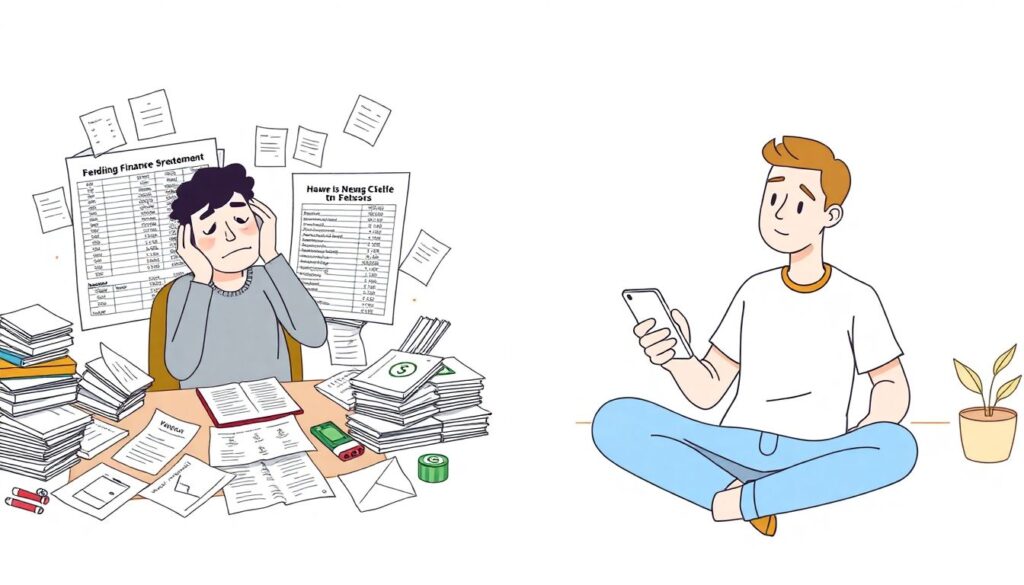
Templates and apps are helpful only if they match your style. A detailed personal financial statement template with dozens of minor categories may look impressive but can become overwhelming, causing people to quit after a week. That’s why many newcomers gravitate to the best apps to manage personal finances and budgets: they simplify categorization, send alerts when spending spikes and often show how small, repeated expenses add up. Survey data from 2021–2023 in the U.S. and Europe consistently shows that households who actively budget and track, even with very basic tools, are significantly more likely—by 15–20 percentage points in some studies—to have three months of emergency savings and to pay credit card balances in full. The tool itself matters less than the habit of revisiting the numbers.
Reading the Numbers: What They’re Telling You
Once you have a few months of statements, start interpreting them like a scientist looking at an experiment. Is your net worth rising, flat, or shrinking? Are certain expense categories, such as food delivery or subscriptions, quietly taking more space every quarter? Comparing your current and past versions of a personal net worth statement worksheet shows whether debt is being replaced by assets or just shuffled around. Between 2020 and 2023, inflation pushed up everyday costs in many countries, but central bank data also show that households who kept detailed spending logs were better able to adjust—cutting discretionary costs, refinancing loans, or negotiating bills—because they knew exactly where their money was going instead of guessing based on memory.
Troubleshooting Common Problems
If your statement doesn’t “balance,” the issue is usually missing information or optimistic estimates. People often forget small debts like buy‑now‑pay‑later plans or underestimate irregular expenses such as car repairs. When numbers look suspiciously good, step back and cross‑check them against bank and card histories or exports from your personal finance software for tracking income and expenses. Another frequent problem is paralysis: after seeing high debt or low savings, some people avoid opening the file again. The constructive approach is to treat each review session as a lab check‑in: you’re not grading your worth as a person, you’re updating a model. Focus on one change at a time—like increasing minimum loan payments by a fixed amount—then measure its impact in the next statement.
Keeping Your Statements Relevant Over Time
A personal finance statement is not a one‑off homework assignment; it’s more like an ongoing research project where your life events—new jobs, moves, kids, health changes—are the experiments. As of the early 2020s, multiple surveys from central banks and financial regulators show that households regularly tracking their net worth and budgets are less likely to carry high‑interest debt and more likely to invest for retirement, even when income is modest. Once a year, zoom out: compare your current statement to the one from twelve months ago and write down two or three concrete trends. Are you building a bigger cushion against shocks, or drifting into dependency on credit? By treating your statements as data instead of drama, you gain the clarity to adjust course before issues turn into crises.