Why Your First Investment Starts With a Boring Budget
Most people search for *how to start investing with a small budget* and immediately jump to stocks, crypto, or some hot app. But here’s the blunt truth:
If you don’t control your cash flow, you’re not investing — you’re gambling.
Planning your first investment while budgeting for beginners isn’t about being “good with money” from day one. It’s about building a simple system where:
– You know exactly what comes in and goes out
– You don’t panic when an unexpected bill arrives
– You can put aside even $25–50 per month and actually keep doing it
Let’s walk through a practical, real‑life way to do this — with numbers, examples, and what experts actually recommend, not just theory.
—
Step 1. See Where Your Money Really Goes (Not Where You Think It Goes)
Before thinking about “best investments for beginners on a low budget,” you need one uncomfortable week: tracking your actual spending.
Take Mia, 26, entry‑level designer, net income $2,600/month. She *thought* she spent about $150/month on coffee, lunches and snacks. When we checked three months of statements, it was $320–360. That’s $200+/month she didn’t even realize she had.
You can do this in the simplest way possible:
– Download the last 1–3 months of bank and card statements
– Highlight expenses in 4 colors: Needs, Wants, Debts, Random “I forgot about this”
– Add each category roughly — don’t chase perfection; you just need the big picture
Now you’re ready for a simple structure.
—
Step 2. Build a Beginner-Friendly Budget You Won’t Quit After a Week
You don’t need fancy software to figure out how to create a budget and start investing at the same time. You just need a formula that’s easy enough to stick to.
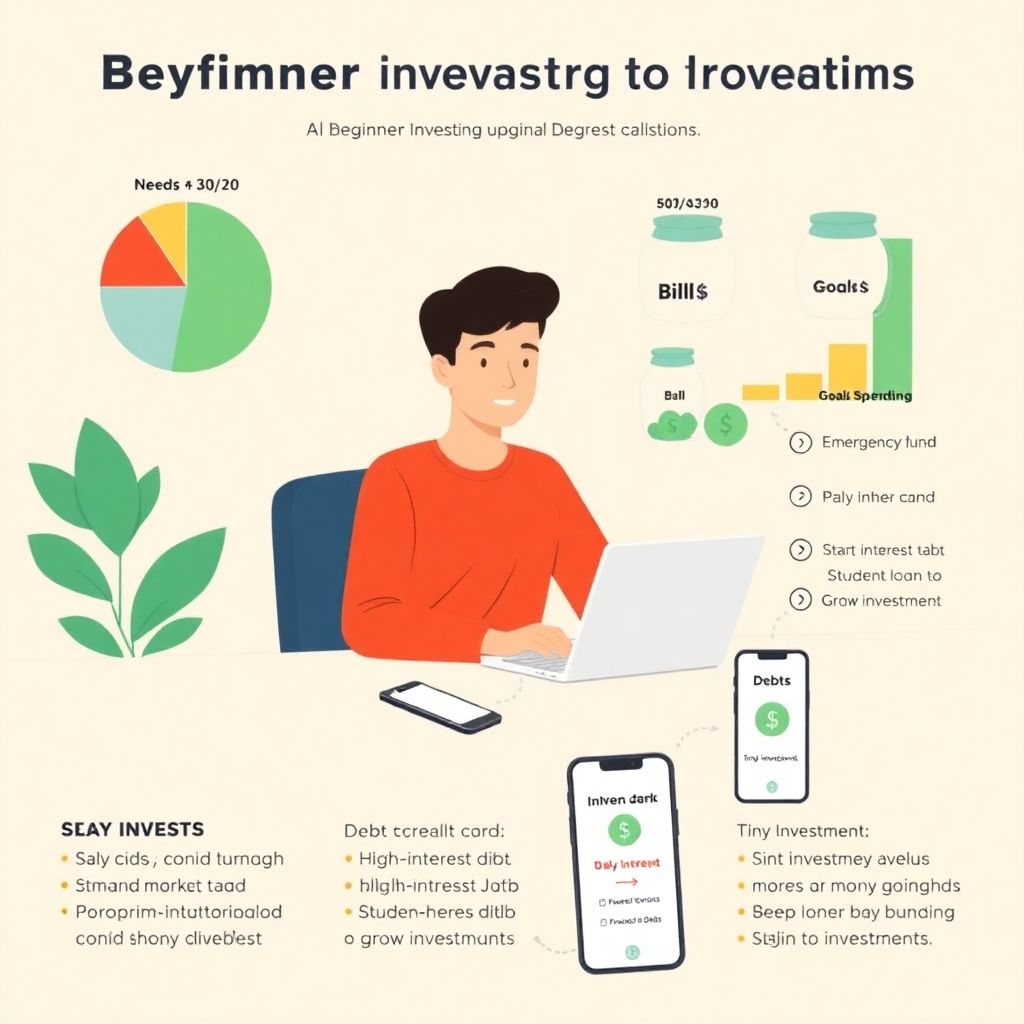
A popular starting point is the 50/30/20 rule, tweaked a bit for reality:
> 50–60% — Needs
> Rent, utilities, basic groceries, transport, insurance
>
> 20–30% — Wants
> Cafés, streaming, clothes, hobbies, small treats
>
> 10–20% — Financial goals
> Debt payments above the minimum + emergency fund + investments
If your rent is high or you live in an expensive city, your “Needs” might hit 65–70%. That’s normal; the point is to see it and decide what’s adjustable.
Real example — a simple starting budget
Net income: $2,500/month
– Needs (60%): $1,500
– Wants (20%): $500
– Financial goals (20%): $500
Inside that $500 for financial goals we might split it like this:
– Extra debt payment: $250
– Emergency fund: $150
– First investments: $100
Suddenly, investing $100/month doesn’t sound impossible. It’s just a line in your plan.
—
Technical Block: Minimum Viable Budget Setup
You can set up a simple system in 30 minutes:
– Account 1 – Main bills account
Salary/paycheck goes here. Rent, utilities, subscriptions are paid from here.
– Account 2 – Daily spending
Transfer a fixed “pocket money” amount weekly (for example, $125 every Monday).
– Account 3 – Goals & investing
Automatic transfers the day after payday:
– Emergency fund (e.g., $75–150)
– Investment account (e.g., $25–100)
Automations:
1. Set recurring transfers in your bank app:
– Payday +1 day → $X to Emergency
– Payday +1 day → $Y to Investment
2. Keep the investment money out of your daily spending account.
This is the backbone of a simple personal budgeting and investing guide for beginners: keep money for your future physically (and mentally) separate from money for today.
—
Step 3. What If You Have Debt? (Spoiler: You Can Usually Still Invest)
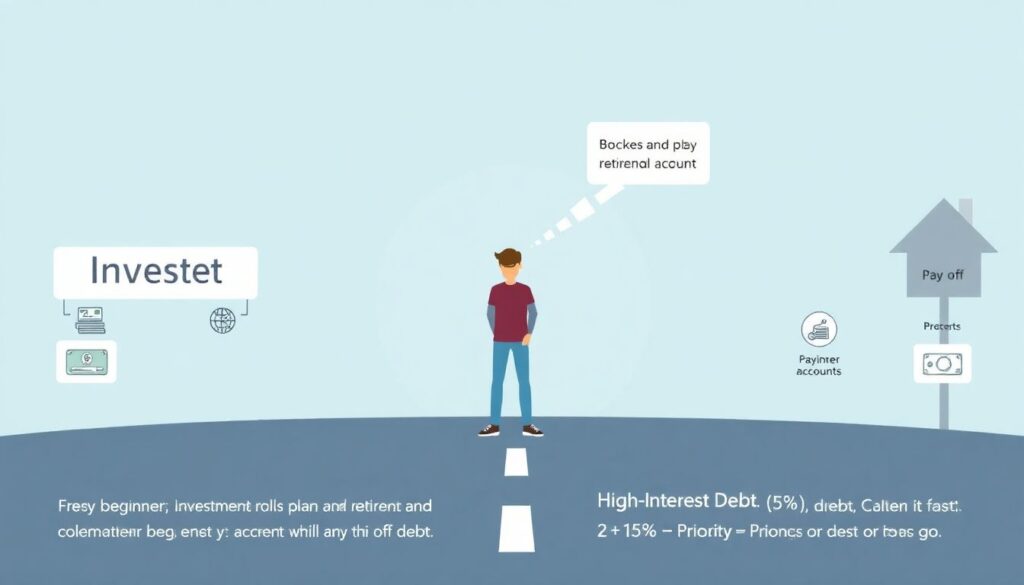
Here’s where many people freeze: *“Should I invest or pay debt first?”*
This is where a beginner investment plan while paying off debt needs nuance, not extreme rules.
Experts generally agree on this:
1. High-interest debt (>15%) — e.g., many credit cards, some personal loans
– Priority: Crush it fast. The “return” on paying off a 22% interest card is basically 22% risk‑free. You won’t safely get that in the market.
– Invest symbolic amounts (like $10–25/month) only to build the habit, not the balance.
2. Medium-interest debt (7–15%) — some personal loans, some cards, certain car loans
– Split strategy:
– Pay more than minimums (aggressively but realistically)
– Start small, consistent investing (even $50/month) to learn the process.
3. Low-interest or “good” debt (<7%) — federal student loans, cheap car loans, some mortgages
– It usually makes sense to invest and pay debt in parallel, especially if you get employer 401(k) match (that’s literally free money).
Example:
Alex has:
– $4,000 on a credit card at 23% interest
– $18,000 in student loans at 4.5%
Alex’s plan:
– Throw every extra dollar at the credit card (target: pay off in 12–18 months)
– Make required payments on student loans
– Invest just $25/month to build comfort with investing apps and not “wait until everything is perfect.”
—
Technical Block: Quick Debt vs. Invest Rule of Thumb
1. List all your debts with:
– Balance
– Interest rate
– Minimum payment
2. Apply this rough rule:
– Interest > 15% → Max extra payments, almost no investing
– 7–15% → Split 70% extra cash to debt / 30% to investing
– < 7% → Focus on building emergency fund + steady investing, just pay minimum or slightly above
3. Add an “emotional” line:
Which debt stresses you out the most?
It may be worth attacking that first even if the numbers say otherwise — behavior matters more than perfect math.
—
Step 4. How to Start Investing With a Small Budget Without Getting Overwhelmed
Let’s keep it real: when you first open an investing app and see dozens of tickers, charts, and products, it looks like a different language.
So, how to start investing with a small budget without going down a YouTube rabbit hole for three weeks?
Use this simple roadmap:
1. Aim for $25–100/month to start. Consistency > Amount.
2. Choose one main type of account (for example, a basic brokerage or IRA/ISA depending on your country).
3. Pick one or two low-cost, diversified investments.
For most true beginners, that means broad-market index funds or ETFs, not individual stocks.
Example:
Income: $2,200/month
Free cash for investing: $50/month
Starter setup:
– Open a brokerage account or tax-advantaged retirement account
– Set up an automatic monthly purchase of:
– $50 into a global stock market ETF or
– $35 into a U.S. or world stock index ETF + $15 into a bond ETF
This sounds tiny, but here’s the math:
– $50/month
– Average 7% annual return (long-term stock market historical average, not a guarantee)
– Time: 30 years
You’re looking at around $60,000–70,000 simply from small, consistent contributions and compounding.
—
Technical Block: What Are Index Funds and ETFs?
Plain-English version:
– Index fund:
A fund that tries to copy a market index (like the S&P 500), holding lots of companies at once. When you buy it, you own a tiny slice of all those companies.
– ETF (Exchange-Traded Fund):
Works very similarly to an index fund, but trades on the stock exchange like a regular stock. You can buy and sell it during market hours.
What matters for beginners:
– Look for low expense ratios (for example, 0.03–0.20% per year).
– A global or total market stock ETF is often a solid core building block.
– Avoid high fees and “guaranteed high return” promises.
This is why experts often name index ETFs among the best investments for beginners on a low budget — they’re diversified, relatively simple, and cheap.
—
Step 5. Expert-Style Priorities: The Simplified Ladder
Here’s a sequence many financial planners roughly agree on, translated into normal language. Think of it as your “ladder.”
1. Cover the basics (month 0–2)
– Pay all bills on time
– Stop adding new debt if possible
– Track spending for at least one full month
2. Starter emergency fund (month 1–6)
– Goal: $500–1,000 as quickly as possible
– This protects your investments from being raided every time your car needs a repair.
3. High-interest debt attack (month 3–18)
– Any debt above ~15%: focus here
– Still invest something tiny ($10–25/month) just for the habit and learning
4. Consistent investing (month 3–36)
– Once high-interest debt is down, redirect that payment into your investments
– Target: 10–15% of your income going to investments over time
5. Full emergency fund (year 1–3)
– Target: 3–6 months of basic expenses in a high-yield savings account
– Only after this should you increase your risk significantly (more stocks, maybe some “fun” speculative bets if you really want)
—
Real-Life Mini Case Study: From Zero to “I’m Actually an Investor”
Jordan, 29, net income $2,800/month
Situation:
– $3,200 on a credit card at 19%
– No savings
– No investments
– Rent + bills: ~$1,650
– Random spending: he had no idea
We built a simple plan:
1. Tracked one full month:
– Found nearly $260/month in “forgotten” spending (subscriptions, eating out, impulse buys).
2. New monthly structure:
– Needs: $1,650
– Wants: $400
– Financial goals: $750
3. Within those $750:
– Credit card: $350 (minimum $90 + extra)
– Emergency fund: $250
– Investments: $150
Results after 12 months:
– Credit card down from $3,200 → $600
– Emergency fund: $2,900
– Investment account: contributions of $1,800; value about $1,950 (market growth)
Jordan’s words: *“I used to think investing was for people who already ‘had money.’ Now I just treat it like a bill I pay to my future self.”*
—
Technical Block: Automating Your First Investment Plan
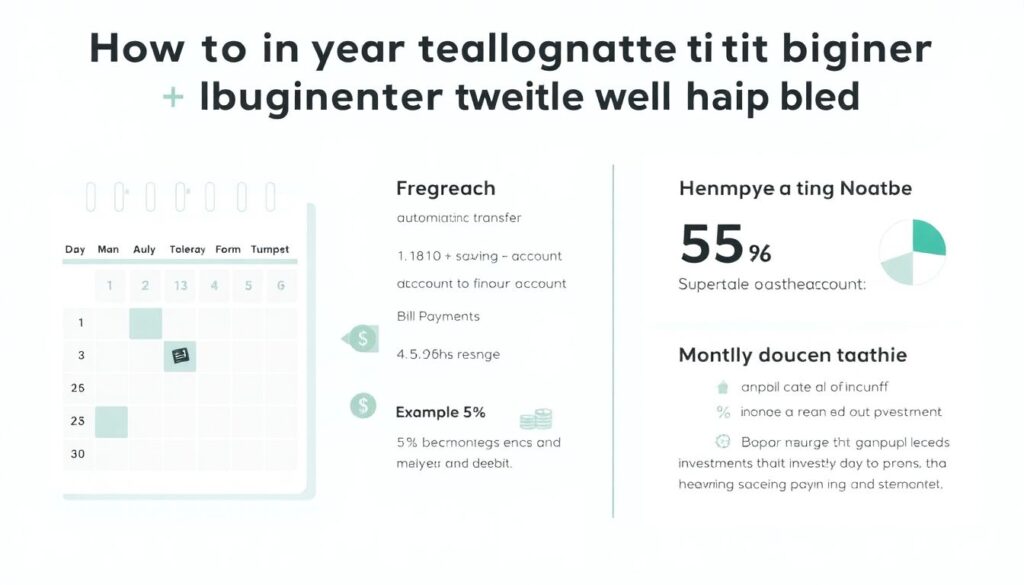
To turn your budget into an actual beginner investment plan while paying off debt, do this:
1. Set fixed dates
– Day 1–3 after payday: automatic transfers to savings and investment accounts
– Later in the month: regular bill payments
2. Decide your monthly investing number
Example: 5% of income to start
– Income: $2,400
– 5% = $120/month → $60 every two weeks, automated
3. Use “round up” features (optional)
Many apps round purchases and invest the extra. It won’t build wealth alone, but it’s a painless bonus.
4. Check your accounts just once a week
Enough to stay aware, not enough to obsess over daily market moves.
Automation solves the biggest beginner problem: forgetting or skipping a month “just this once.”
—
What the Pros Say (Decoded into Normal Language)
Here are distilled expert recommendations you’ll hear again and again, stripped of jargon:
1. “You are your first asset.”
Before chasing returns, invest in skills that raise your income. A certificate or course that can add $300/month to your paycheck usually beats squeezing an extra 1% return out of your portfolio.
2. “Time in the market beats timing the market.”
Translation:
It’s more important to start with $25/month now and stay consistent for 10+ years than to wait three years until you have the “perfect” amount or the “perfect” moment.
3. “Asset allocation matters more than stock picking.”
In practice:
– Decide roughly: what % in stocks, what % in bonds/cash, based on your risk tolerance and time horizon
– Stick to that, rebalance once or twice a year
– Don’t stress about choosing the “perfect” company
4. “Don’t let perfect be the enemy of good.”
Your first budget will be messy, your first investment might feel random. That’s fine. The *habit* is the win.
—
1–2–3 Action Plan to Start This Week
1. Tonight:
– Open your banking app
– List income + top 10 recurring expenses
– Decide on a realistic amount you can move to “Financial goals” (even $30–50)
2. This weekend:
– Open a simple investment account (brokerage, IRA, ISA — whatever fits your country)
– Set up $25–100/month auto-invest into a low-cost broad-market ETF or index fund
3. This month:
– Build a mini emergency fund target (first goal: $500–1,000)
– Identify your highest-interest debt and make a plan to increase payments by at least $20–50/month
From that point on, every paycheck you get, a small piece starts going to Your Future You — automatically.
That’s the core of a realistic, personal budgeting and investing guide for beginners:
Not magic, not luck, just a plan that respects your current reality while quietly building something bigger in the background.