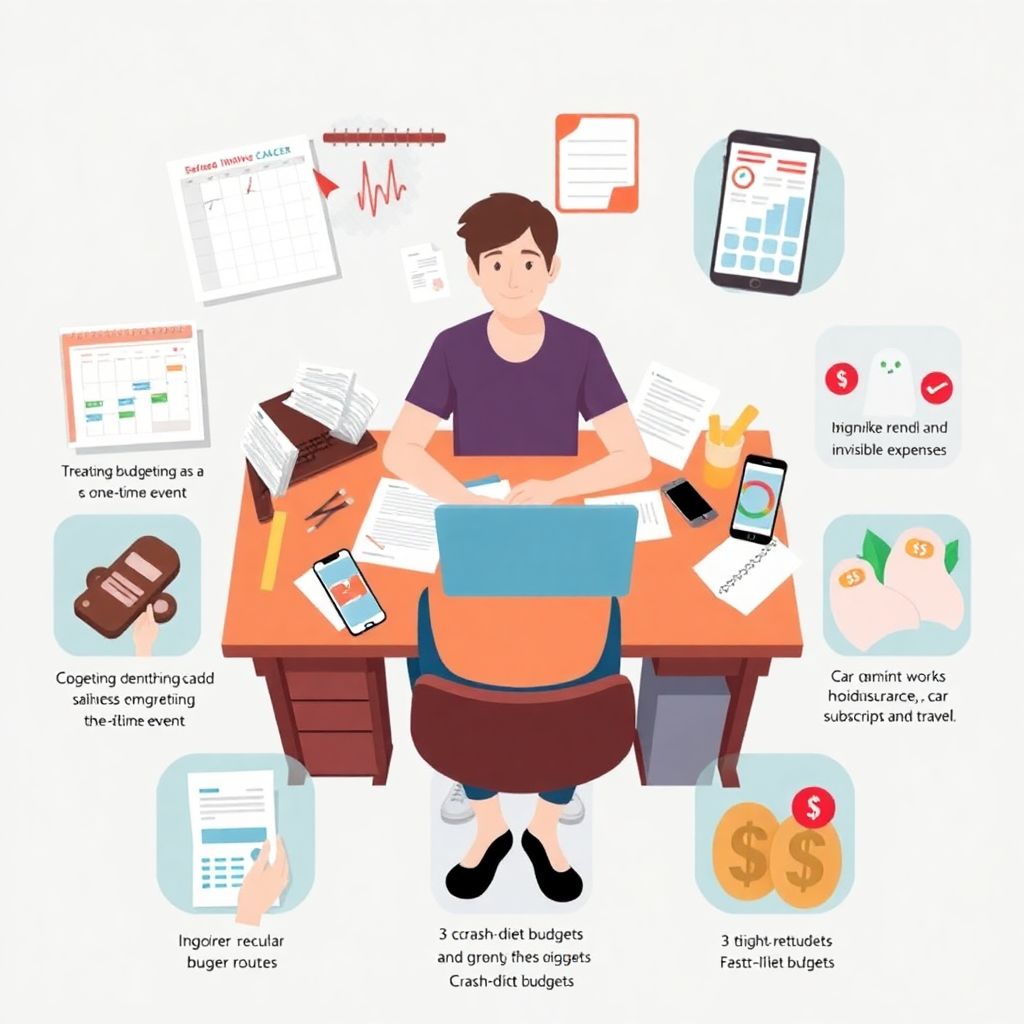
Most people don’t mess up their money because they’re “bad with numbers”. They mess up because budgeting feels abstract, boring, or like a diet you’ll eventually “cheat” on. Surveys from the U.S. and Europe regularly show that roughly 60–65% of adults either don’t use a budget at all or keep one only in their head, while about the same share say they live paycheck to paycheck. That’s not just a personal problem: it shapes how banks design products, how fintech startups build apps, and how regulators think about consumer debt. If so many beginners stumble in the same places, it makes sense to dissect the most common budgeting mistakes and look at different ways to fix them—old-school notebooks, the best budgeting apps for beginners, and even working with a financial coach or taking an online course.
—
1. Mistake: Treating Budgeting as a One-Time Event

Most newbies see budgeting like setting up a new phone: you do it once, tap “OK” a few times, and forget about it until something breaks. In reality, your budget is closer to a navigation app: it needs constant recalculations because life keeps throwing “new route” alerts at you—rent changes, inflation creeps up, your hours get cut, or you suddenly decide that rock climbing is your entire personality. Economically, this is crucial. In an environment where consumer prices move faster than salaries, a static plan becomes useless within months. Longitudinal data from central banks and statistical agencies show real wages barely keeping up with inflation in many countries; if you don’t update the numbers, you’re budgeting for a past reality. That also influences the personal finance industry: recurring subscription apps, AI-driven notifications, and automated cash-flow tools are built around the idea that money planning must be continuous, not one-and-done.
New approach? Think “budgeting session”, not “budget file”. Fifteen minutes once a week to adjust categories, check what changed, and move money around beats a perfect spreadsheet you open twice a year.
How to Fix It: Choose a System You’ll Actually Touch

When people ask how to create a personal budget step by step, they usually want a magic template. But the right answer depends on your personality. If you love writing and reflective planning, a paper budget planner for new budgeters might keep you engaged because it feels like journaling, not accounting. If you live on your phone, pick a simple app you can open in a grocery line. Some apps auto-import transactions, others force you to enter everything manually. Automation saves time but can make you disengage; manual entry builds awareness but can be tiring. That’s why the industry is moving toward hybrids: semi-automatic tracking plus human-friendly summaries. The real metric of success is not how fancy the tool looks but whether you’re still updating it three months from now.
—
2. Mistake: Ignoring Irregular and “Invisible” Expenses
Beginners typically remember rent, groceries, transport—and forget literally everything else. Then the annual car insurance, dental work, or holiday gifts smash their “perfect” plan. Statistically, households in developed economies spend a sizable share of their income—often 15–30%—on irregular or semi-regular items: medical co-pays, travel, school supplies, subscriptions that renew quietly. When these costs are not forecast, people fall back on credit cards or “buy now, pay later”. On a macro level, that contributes to the revolving credit balances that central banks monitor so closely. Fintech sees this gap as a business opportunity: new budgeting tools flag upcoming renewals, simulate annualized costs, and nudge users to build sinking funds. For the industry, helping users handle irregular expenses is key to reducing churn: fewer painful “surprises” means fewer people rage-quitting apps and saying “budgeting doesn’t work for me.”
Short version: if it happens every year, it’s not an emergency; it’s a badly forecast expense.
How to Fix It: Sinking Funds vs. Buffer Approach
There are two main approaches, and both are valid. Sinking funds mean you create mini-buckets—car, health, gifts, travel—and send a fixed amount to each monthly. This method is beloved by many a financial coach for help with budgeting because it forces discipline and visibility: you see that next year’s vacation is quietly funded. The downside is complexity; too many tiny pots can feel like advanced Excel and scare new budgeters away. The alternative is a broad “life happens” buffer: you keep, say, one extra month of average expenses in a savings account and use it for any irregular cost, then refill it. Simpler, but easier to raid for non-essentials. Industry trends show apps increasingly offering both: labeled goals for people who like structure, plus a generic safety cushion. Try one system for three months; if you keep “borrowing” from your future travel fund for takeout, you might be a buffer person, not a sinker.
—
3. Mistake: Using Unrealistic, “Crash-Diet” Budgets
Another classic: you decide you’ll become a money genius starting Monday. You cut eating out to zero, entertainment to “maybe once a year”, and promise to save half your income. For two weeks you white-knuckle your way through, then one stressful day nukes the plan, and you swing back to “I’m just bad with money.” Behavioural economists have studied this yo‑yo dynamic for years: ambitious self-control without realistic constraints usually backfires. Similar to aggressive dieting, crash budgets create a cycle of guilt and overspending. At the household level, that volatility can even affect retail industries; when many consumers alternate between extreme frugality and splurges, subscription services and retailers see more churn and unpredictable revenue. This is one reason the market for gentler tools—apps that emphasize trends and “better than last month” wins rather than strict limits—is growing. Forecasts for personal finance software suggest steady expansion driven by demand for psychologically aware design, not just sharper graphs.
If you can’t imagine living with your budget for at least a year, it’s probably too strict.
How to Fix It: Gradual Cuts vs. Income-First Strategy

There are two broad paths here. One is to soften the budget: instead of slashing dining out from $300 to $0, cut to $220 and see if that’s sustainable. Use your first month not to be perfect, but to collect real data. Many of the best budgeting apps for beginners now show averages by category so you can trim 10–15% instead of guessing. The other path flips the script: instead of obsessing over cutting lattes, you focus on raising income—overtime, skill upgrades, freelance gigs—and keep your lifestyle mostly the same while channeling new money into savings and debt payoff. Economically, this aligns with the reality that there are hard limits to how much you can cut but theoretically no ceiling on earning potential. The future of budgeting education is likely a mix: teaching people basic cost awareness while heavily emphasizing career capital and income growth as the main long-term lever.
—
4. Mistake: Budgeting Only in Your Head (or Only in an App)
Plenty of people say, “I know roughly what I spend, I don’t need to write it down.” Research on human memory disagrees. When banks and universities compare self-reported spending to actual card data, people typically underestimate certain categories—especially small, frequent purchases—by large margins. But here’s a twist: the opposite extreme also fails. Relying blindly on an app without ever thinking about the numbers turns budgeting into background noise. Many users download three or four apps, play with them for a week, then uninstall them all, which is why app analytics firms report high churn: more than half of new budgeters quit within the first 90 days. For the personal finance industry, this is a retention crisis and an innovation opportunity at the same time. The next wave of tools is less about tracking for tracking’s sake and more about translating data into simple, human decisions: “Can I afford this trip if I still want to pay off my card in six months?”
Mental math alone is wishful thinking; pure automation without attention is autopilot with foggy sensors.
How to Fix It: Manual, Hybrid, and Guided Approaches
Here’s where different problem-solving strategies come in. The fully manual method—spreadsheet or notebook—gives you maximum awareness but demands time and discipline. Some people love it; for them, a physical budget planner for new budgeters is like a ritual that keeps them grounded. The fully automated method—connect accounts, let AI sort categories—suits tech‑friendly folks who mainly need to see big patterns. A hybrid approach might be healthiest for most: let an app track the bulk, then manually review or adjust key categories weekly. To go deeper, an online budgeting course for beginners can walk you through real-life scenarios and common traps; many courses are starting to include behavioural nudges and community support, not just math lessons. Pairing that with a certified financial coach for help with budgeting offers yet another layer: a human who can challenge your assumptions, spot blind spots, and adapt general advice to your actual life—something no app fully replaces yet.
—
5. Mistake: Budgeting Without Goals or a Bigger Story
Finally, the stealth killer: a budget with no purpose. If all you see is “spend less, save more”, your brain files it under “chore” alongside cleaning the fridge. That’s why so many first-time budgets die after tax season. On the other hand, when people map their money to concrete life goals—pay off a $3,000 card in 10 months, save a down payment in three years, fund a career change—the same numbers suddenly feel like tools, not punishment. This shift has broader economic implications. When millions of households start targeting debt reduction and buffer-building, default rates tend to fall, which banks and regulators obsess over. It also propels new niches: goal-based robo-advisors, gamified saving apps, and specialized courses for milestone planning (weddings, babies, sabbaticals). Industry analysts expect this “goal-first” segment to keep expanding as financial literacy campaigns, employer benefits, and social media creators all hammer home the idea that money is a means, not an end.
If your budget doesn’t answer “what am I building toward?”, motivation will evaporate the moment life gets stressful.
How to Fix It: Numbers Plus Narrative
To repair this, you don’t need a vision board—just clarity. Start with one short-term, one medium-term, and one long-term goal, each with a number and a date. Then rewrite your budget categories in that language: instead of “leftover”, call it “New laptop fund – December” or “Debt‑free by 2027”. Different tools support this in different ways: some apps let you set visual progress bars, while minimalist spreadsheet lovers might just add a line at the top: “Target: $5,000 emergency fund by next June.” Even traditional banks are catching up, rolling out features that let customers label sub‑accounts as “goals”. The trend in the industry is clear: as more people adopt goal-based budgeting, demand grows for smarter analytics, predictive cash‑flow tools, and tailored advice—whether that’s through an app, a course, or a human coach. And for you personally, it means your budget stops being a list of “no’s” and turns into a map of “here’s how I get there.”
—
Budgeting isn’t about becoming a monk or memorizing every receipt. It’s about avoiding a handful of predictable rookie mistakes—treating it as a one-off task, forgetting irregular costs, setting crash‑diet rules, outsourcing everything to either your brain or your app, and skipping goals altogether. Fix those, in whatever style suits you, and the numbers start working with you instead of against you. And as more beginners get this right, the whole personal finance ecosystem—from software to coaching to banking products—shifts toward tools that respect how people actually live, not how a textbook says they should.