
Why budgeting is not about deprivation
When people hear “budget”, many instantly picture endless restrictions, boring spreadsheets and a ban on every little pleasure. In reality, a sustainable financial plan is much closer to a navigation system: it shows where your money is going and helps you steer it toward what actually matters to you. Budgeting for beginners should not start with guilt or shame, but with curiosity: what does your current money picture really look like, and how can you adjust it so that it supports your life instead of stressing you out? Once you treat a budget as a flexible tool, not a punishment, it becomes easier to build habits that will survive busy weeks, salary changes and unexpected expenses without collapsing at the first serious challenge.
Step 1. Measure before you fix: real income and real expenses

Before thinking about how to create a personal budget plan, you need a clear starting point. Most people roughly know their income, but significantly underestimate everyday spending: small online subscriptions, random snacks, ride-hailing, impulsive online purchases. Spend one full month tracking every money movement. No need to complicate things: a simple note-taking app or even pen and paper is enough if you’re consistent. Fix net income (after taxes) and divide expenses into large natural categories: housing, food, transport, debts, entertainment, learning, health, gifts, “miscellaneous”. The goal is not to impress anyone, but to collect honest data; treat yourself like a researcher, not a judge, so you don’t start hiding transactions even from yourself.
Practical tracking tips for a lazy brain
To keep tracking realistic, build it into actions you already do. Each time you pay, immediately log the expense before putting away the card, just like you already enter a PIN code. Turn on notifications in your banking app and once a day scroll through them, assigning categories. If you prefer automation and want a digital helper, explore the best budgeting apps for beginners: many of them sync with bank accounts, automatically categorize spending and show diagrams that make your financial picture visually obvious, so you don’t need to build any complex Excel files. The simpler the routine, the higher the chance you will continue after the first week, when initial enthusiasm inevitably fades and daily inertia returns.
Step 2. Decide what you actually want from your money
A sustainable financial plan starts not with numbers, but with priorities. Money is a limited resource, and if you don’t define directions consciously, other people’s expectations and advertising will gladly decide for you. Write down 3–5 goals for the next year and 3–5 for the next five years. Short term can include building a small emergency fund, paying off a credit card, or taking a modest vacation without going into debt. Long term may be a house down payment, career change, or early partial retirement. Try to express goals through specific amounts and deadlines, not vague wishes, because the brain handles concrete tasks better than abstract desires that never turn into actionable steps.
How to turn vague goals into concrete targets
Take one goal and “dissect” it. Suppose you want an emergency fund equal to three monthly expenses. If your average month costs $1,500, target is $4,500. If you can save $150 per month, you’ll need 30 months. This already gives structure: the goal is no longer a foggy “someday”, but a project with a timeline. Do the same with other key intentions. Break large goals into smaller milestones: the first $300 saved, the first $500 of debt repaid, the first month with no overdraft. Celebrating these small checkpoints prevents burnout; your motivation stops depending on distant, almost mythical results and starts feeding on real progress you can see in your account and daily decisions.
Step 3. Build a simple budget framework you can actually follow
Once you know your baseline and priorities, you can assemble a basic structure. For budgeting for beginners, complex formulas are rarely helpful. Many start with proportional rules, like 50/30/20: about 50% of net income for “needs” (housing, food, basic transport, minimum debt payments), 30% for “wants” (cafes, hobbies, streaming) and at least 20% for “future” (savings, investments, extra debt payments). This is not a law but a starting template; adjust percentages to your situation. If rent eats 60%, it’s okay, just squeeze “wants” more tightly and look for ways to increase income over time. Key idea: every incoming dollar gets a job, so you never say “I don’t know where the salary disappeared this month.”
Zero-based budgeting in plain language
Another practical method is zero-based budgeting. It does not mean leaving your account empty; it means that at the planning stage every unit of income is assigned to a concrete purpose, until the difference between planned income and planned expenses equals zero. Salary arrives – and you already know how much goes to rent, how much to groceries, how much to transport, how much to investments, and how much to pure fun. This helps avoid the trap of “leftover logic” when savings only happen if something randomly remains unspent. Use any format you prefer: notebook, spreadsheet, app. What matters is that in a few minutes you can see which category you are overspending in and what exactly needs a correction before the month derails financially.
Step 4. Automate boring things: savings and bills
The more often your progress depends on willpower, the more unstable your budget becomes. Sustainable systems rely on automation, not heroic self-discipline. Set up automatic transfers: right after payday, a fixed amount goes straight to savings or investment account, and only then you start spending the rest. That way you pay yourself first, not last. Do the same for regular bills: rent, insurance, recurring subscriptions. When payments are predictable and automatic, you reduce both late fees and mental load. Our brain tires quickly from constant small decisions; if you free it from daily financial micro-choices, it becomes easier to stick to big-picture principles without drowning in endless routine questions like whether to postpone a transfer one more day.
Separate accounts for clarity and self-control
An effective budget hack is to separate money by function. Keep one account for fixed expenses and another for variable spending like food, transport and entertainment. When the variable account empties, this serves as a clear signal that it’s time to slow down, without risking rent money. Some even use a third account exclusively for long-term goals and avoid touching it except for designated purposes. Technically, nothing prevents you from transferring funds between accounts, but this extra friction often gives a pause: you ask yourself why you’re doing it and whether an impulsive purchase truly beats your goal of financial stability. Even this short moment of reflection can noticeably reduce random, unplanned spending.
Step 5. Protect yourself from shocks: emergency fund and insurance
No budget is sustainable if any surprise expense instantly ruins it. An emergency fund is a separate cash buffer you do not use for vacations or gadgets, only for real emergencies: job loss, medical bills, urgent repairs. For beginners, even $500–$1,000 already changes the psychological landscape: you stop fearing every broken tire or sudden dental visit. Over time, aim for 3–6 months of basic expenses. Keep this money in a highly liquid, low-risk place such as a savings account, not in speculative assets. Combine this with adequate insurance coverage: health, basic property, perhaps disability if available. A financial plan is sustainable not because nothing bad ever happens, but because you’ve built in shock absorbers that soften inevitable life bumps.
How to build a buffer when money is tight
If there’s almost no slack in your budget, think in micro-steps. Decide on a symbolic but regular amount: $10–$20 a week transferred automatically into a separate emergency pot. Add irregular sources: tax refunds, gifts, side gigs, selling unused items. Assign a fixed share of any unexpected income, for example 50%, to your safety cushion. On paper, such small contributions look insignificant, but their effect accumulates: three months of this approach can already prevent going into debt for minor issues. It’s important not to mix the emergency fund with other savings; if you constantly dip into it for planned purchases, it will not be there when a real problem arises and you most need that silent financial backup.
Step 6. Deal with debt strategically, not emotionally
Debt often feels like a giant dark cloud over any attempt at budgeting. Instead of panicking, turn it into a concrete project. List all debts with interest rates, minimum payments and balances. Two classic approaches exist. The avalanche method targets the highest interest first: you pay minimums on all debts and put any extra money toward the most expensive one, which minimizes total interest paid. The snowball method targets the smallest balance first: you close small debts quickly, gaining motivation and freeing up payments for the next. Mathematically, avalanche wins, but psychologically, snowball can be more sustainable. Choose the method you are more likely to follow for a year, not the one that looks better only on paper during initial enthusiasm.
Negotiation and restructuring: underrated tools
Many people never try to talk to creditors, although in practice this can ease the pressure significantly. Call your bank or lender and ask if they can lower your interest rate, extend the term, or offer temporary restructuring. Prepare in advance: know your numbers and explain your situation clearly without drama. In some cases, refinancing high-interest debt into a lower-interest product makes sense, but only if you simultaneously change spending habits; otherwise, the freed-up room will quickly be filled with new obligations. A sustainable financial plan treats debt reduction as a scheduled marathon task, not as a desperate sprint that leaves you exhausted and triggers relapse into old patterns of uncontrolled borrowing and emotional spending.
Step 7. Use education and professional help wisely
If you feel overwhelmed, remember that personal finance literacy is a learnable skill, not an innate talent given only to a chosen few. You can start with free or low-cost budgeting courses for beginners online to understand basic terminology, typical mistakes and practical frameworks. Videos, articles and interactive calculators help you see how small changes in behavior lead to significant long-term results. For those who want more structured guidance, some banks, non-profits and community organizations provide free sessions or group workshops. Staying curious and regularly updating your knowledge protects you from outdated advice and allows you to adapt your strategies as your income, responsibilities and long-term goals evolve with time.
When to bring in outside experts
There comes a point where it may be reasonable to hire a financial advisor for budgeting and savings, especially if your situation includes multiple income sources, early investments or complicated debt. For many, this feels like a luxury, but a good specialist can prevent costly mistakes and help align your plan with tax rules and realistic assumptions. At the same time, be selective: understand how your advisor is paid, what their qualifications are, and whether they are obligated to act in your best interest. Some firms and independent planners focus on financial planning services for young adults, offering short consultations or limited-scope plans rather than expensive lifelong management, which makes professional advice more accessible at the start of your financial journey.
Step 8. Review, adjust and stay flexible
No budget will be perfect from day one, and that’s fine. Think of the first three months as an experiment rather than a final exam. At the end of each month, sit down with your numbers for 15–20 minutes. Look at where you overspent, where you underused planned amounts, and which categories felt too tight or too loose. Ask why: was it a one-time event, a seasonal factor, or a sign that your original assumptions were unrealistic? Adjust limits for the next month instead of stubbornly clinging to a plan that doesn’t fit your actual life. Sustainability is built from many small iterations; your budget should move with you like comfortable clothing, not restrict you like a rigid corset that you can’t wait to tear off.
Simple monthly check-in checklist
- Compare planned income and actual income; note any differences and their reasons.
- Review each major expense category and mark where emotions drove decisions.
- Evaluate progress toward savings and debt goals; update balances and timelines.
- Decide one concrete change for next month: a new limit, an automation, or a cut.
- Briefly write down what worked well; reinforce these behaviors consciously.
Step 9. Make your budget support your values, not fight them

The most durable budgets are those that take human nature seriously. You won’t turn into a different person just because you drew up a spreadsheet. If you adore coffee with friends or saving for travel, don’t try to wipe these items out; instead, allocate a realistic but finite amount for them. When pleasure is planned, it stops sabotaging essential priorities. Build small rewards into your financial plan: for example, after three months of consistent tracking and saving, allow a modest treat that doesn’t wreck your progress. Over time, you’ll see that budgeting for beginners is not about saying “no” to everything, but about confidently saying “yes” to what you truly care about, with numbers that confirm your decisions, not contradict them.
Putting it all together: a living, evolving system
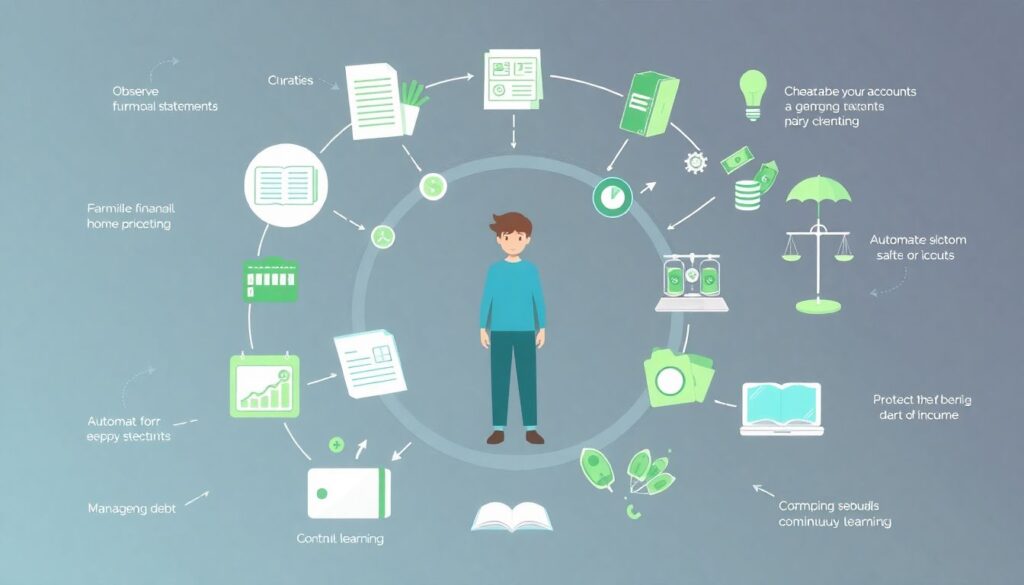
A sustainable financial plan is not a one-time document you write and forget; it’s a living system that grows with you. You start by observing your current situation, then define priorities, create a simple structure, automate key flows, protect yourself from shocks, manage debt, learn continuously and adjust regularly. Each step is small on its own, but together they change your relationship with money from chaotic reaction to deliberate action. Give yourself permission to make mistakes, learn and refine; consistency beats perfection. When your plan reflects both mathematical reality and your personal values, money stops being a constant source of anxiety and becomes a quiet but reliable ally in building the life you actually want to live.