
Why Starting Early Changes Everything
Saving for retirement can feel like trying to plan for another lifetime. In your 20s or early 30s it’s even worse: bills are real, retirement is abstract. But the truth is boring and powerful — the earlier you start, the less you actually need to save overall.
Let’s unpack that without fluff and with clear numbers you can actually use.
When you save early, you’re not just adding money; that money earns returns, and those returns earn returns. That’s called compound interest.
Definition (simple):
Compound interest = money you earn on your initial savings plus money you earn on the previous earnings.
Think of it like this “diagram” in text:
– Year 1: You → put in $100 → it earns $10 → you have $110
– Year 2: You → add $100 → now $210 → it earns $21 → you have $231
– Year 3: You → add $100 → now $331 → it earns $33.10 → you have $364.10
The growth is no longer a straight line; it curves upward. Starting in your 20s gives that curve a lot more time to bend.
—
Step 1: Get Clear on the Goal (What Are You Even Aiming For?)
Before you decide where to put your money, you need to know what you’re trying to fund.
Key Terms You’ll See Everywhere
Let’s define a few things in plain English:
– Retirement savings – The money you’re putting aside now to live on when you stop working full‑time.
– Retirement account – A special type of account (like a 401(k) or IRA) that gives you tax advantages if you use it for retirement.
– Tax‑advantaged – The government gives you a tax break either now or later if you use the account correctly.
– Risk tolerance – How much temporary loss in your investments you can handle without panicking and selling.
You don’t need a perfect 40‑year plan. You just need a direction and a monthly number you can commit to.
—
How Much Might You Need?
You’ll see different “rules,” but a simple starting point:
– Aim to replace roughly 60–80% of your pre‑retirement income from your savings plus any pensions or social security.
Example:
If you think you’ll want the equivalent of $4,000/month in retirement, perhaps $3,000 of that needs to come from your own investments.
This is where a retirement savings calculator for beginners becomes useful. Even the simplest calculators let you plug in:
– Your age
– How much you’ve saved (even if it’s zero)
– How much you’ll save each month
– A rough expected annual return (often 5–8% in examples)
Play with numbers. Double your monthly contribution in the calculator and watch the final value. That feedback is powerful.
—
Step 2: Answer the Big Anxiety Question: “How Much Should I Save?”
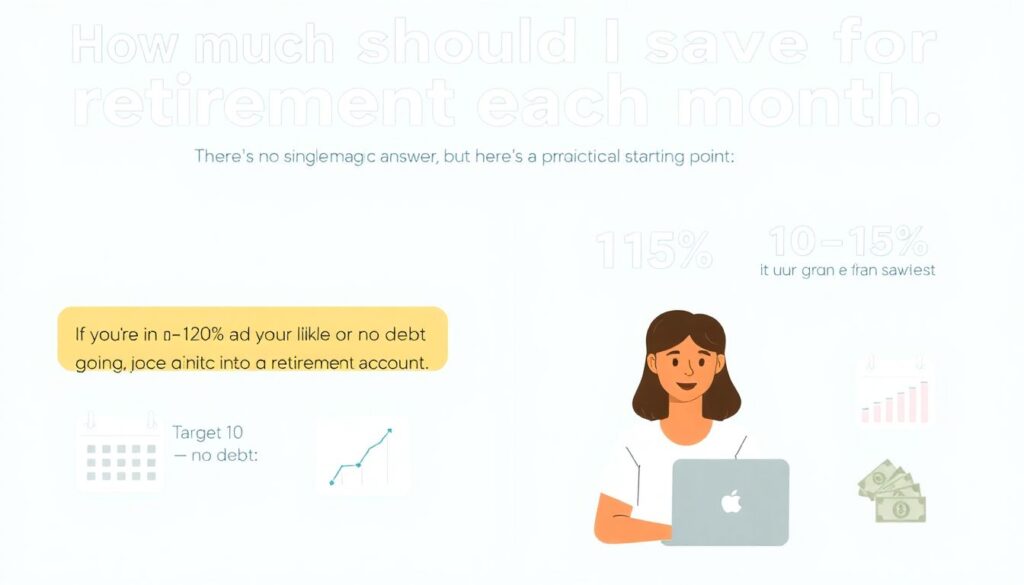
Let’s address the phrase that lives in everyone’s head: “how much should I save for retirement each month?”
There’s no single magic answer, but there are practical starting points.
1. If you’re in your 20s and have little or no debt:
– Target 10–15% of your gross income going into retirement accounts.
2. If you’re starting in your 30s:
– Try to push that toward 15–20% if you can.
3. If that sounds impossible:
– Start with 3–5%, then bump it by 1–2 percentage points every 6 months.
Mini diagram (mentally compare these two):
– Start at 25:
– Save $250/month, earn 7%/year, stop at 65
– Roughly: ends at around $600k–$700k (ballpark)
– Start at 35:
– To hit the same ballpark, you might need $500/month or more
Same destination, but the late starter has to walk faster and harder.
—
Step 3: Pick the Right Type of Account
This is where terms start to sound like alphabet soup. Let’s sort them out in everyday language.
Work Retirement Plans (401(k), 403(b), etc.)
If your employer offers a 401(k) (or 403(b)/TSP for some sectors), that’s usually the first door to open.
– You contribute straight from your paycheck.
– You often get a match: the company adds money if you do.
Example:
Your employer offers a 3% match. You make $3,000/month. If you put in 3% ($90), they also put in $90.
That’s a 100% instant return on that $90. Hard to beat.
When people look for the best retirement plans for young adults, a solid employer plan with a good match is usually at the top of the list, because free money always wins.
—
IRAs and Roth IRAs
If you don’t have a work plan, or you want to save in addition to it, you have:
– Traditional IRA – You may get a tax deduction now; you pay taxes later when you withdraw in retirement.
– Roth IRA – You pay taxes now; withdrawals in retirement are generally tax‑free (if you follow the rules).
In plain terms:
– Traditional: “Pay less tax now, more later.”
– Roth: “Pay tax now, maybe nothing later.”
For many young people just learning how to start saving for retirement in your 20s, the Roth IRA is often recommended because:
– Your income and tax rate are usually lower now.
– Decades of tax‑free growth can be a huge advantage.
When you research the best Roth IRA accounts for beginners, focus less on brand hype and more on:
– Low or no account fees
– Access to low‑cost index funds
– Simple, easy‑to‑use app or website
– No weird minimum balance requirements
—
Quick Comparison with Just Keeping Cash
Let’s compare storing money in a savings account vs. a Roth IRA invested in a simple stock index fund.
Scenario A – Savings Account
– $200/month
– 1% interest
– 40 years
Scenario B – Roth IRA in Stock Index Fund
– $200/month
– 7% average return
– 40 years
Ballpark outcomes:
– Scenario A: ends around $120k
– Scenario B: ends closer to $500k+
Same monthly effort, totally different result. That’s why “investing” vs. just “saving” matters for retirement.
—
Step 4: Decide Where Your Money Actually Goes (Investing Basics)
Putting money into a retirement account is step one. You then have to choose investments inside that account.
Key Terms Again, in Simple Form
– Stock (equity) – Small slice of a company. Higher growth potential, more ups and downs.
– Bond (fixed income) – Loan to a government or company. Lower growth, usually steadier.
– Index fund – A fund that simply tracks a market index (like the S&P 500) instead of a manager trying to “beat” it.
– ETF (exchange‑traded fund) – Similar to a mutual fund, but it trades like a stock during the day.
For beginners, a low‑cost index fund or a target‑date fund is often the easiest option.
– Target‑date fund: You pick a year close to when you plan to retire (say 2060). The fund automatically adjusts mix of stocks/bonds over time.
—
Text Diagram: Risk Mix Over Time
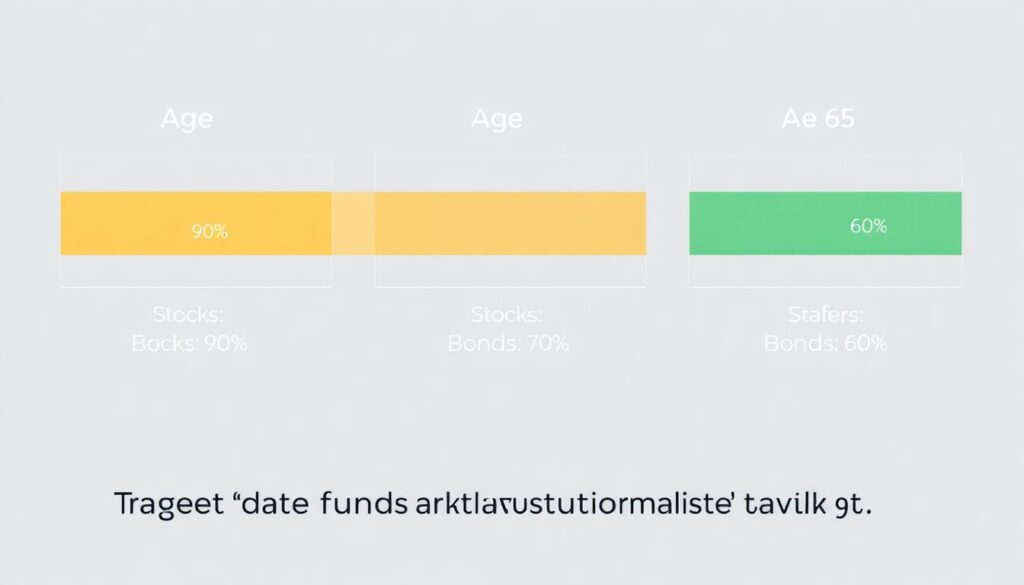
Imagine your portfolio over decades:
Age 25:
[ Stocks: ██████████ 90% ] [ Bonds: ██ 10% ]
Age 45:
[ Stocks: ████████ 70% ] [ Bonds: ████ 30% ]
Age 65:
[ Stocks: ████ 40% ] [ Bonds: ███████ 60% ]
Target‑date funds just automate that shift for you.
—
Step 5: Build a Simple, Realistic Game Plan
Let’s turn all this into something you can actually do in a weekend.
1. Get Your Safety Net First
Before you throw everything into retirement accounts, avoid the trap of investing without a cushion.
1. Build a small emergency fund:
– Aim for 1 month of bare‑bones expenses at first.
– Later, try for 3–6 months.
2. Pay off high‑interest debt (like 18% credit cards) as a priority — that “return” from not paying huge interest often beats investment returns.
—
2. Grab the Free Money (Employer Match)
If you have a 401(k) with a match:
1. Log into your HR/benefits portal.
2. Set your contribution at least high enough to get the full match.
3. Choose a simple target‑date fund or broad index fund.
Think of this as non‑negotiable baseline: you don’t walk away from free money.
—
3. Add a Roth IRA (If It Fits Your Situation)
Once you’ve captured any match, consider:
1. Open a Roth IRA at a low‑cost brokerage.
2. Set up automatic transfers every payday.
3. Invest in:
– One broad US stock index fund, or
– A target‑date fund for your retirement year.
This combo — 401(k) + Roth IRA — is one of the best retirement plans for young adults because it balances tax benefits now and later, plus it’s simple to maintain.
—
4. Use a Calculator to Test “What If?”
Use a retirement savings calculator for beginners and try:
– Scenario 1: Save $150/month until 65
– Scenario 2: Save $200/month until 65
– Scenario 3: Save $250/month until 65
Looking at these side by side quickly answers “how much should I save for retirement each month” for your comfort level and goals. You’ll see how even small increases in your 20s can shave years off your working life.
—
Step 6: Automate, Then Forget (Mostly)
Once your setup is in place, you want the system to run without constant willpower.
Automate Contributions
– 401(k): taken from paycheck automatically.
– Roth IRA: set an automatic monthly transfer from your checking account.
Your future self doesn’t care if the money went in on the 3rd or the 15th; it just cares that it went in.
—
Automate Your Increases
If your budget is tight, start low and commit to automatic raises:
– Every time you get a pay raise, bump retirement contributions by 1–2%.
– Or set a calendar reminder every 6 months to raise it a little.
Mini example:
You start at 4% at age 24, then add 1% per year until you hit 15%. You gradually move toward a strong savings rate without shocking your lifestyle.
—
Step 7: Understand the Emotional Side (So You Don’t Self‑Sabotage)
Knowing the math is one thing. Facing real‑world volatility is another.
What Market Drops Feel Like
You’ll eventually see your account drop by 10–30% in a bad year. That’s normal, but it never feels normal.
Text “diagram” of what typically happens:
– Year A: Market rises +15% → You feel smart
– Year B: Market falls −20% → You feel like pulling everything out
– Year C: Market rises +18% → Long‑term investors recover and move ahead
If you’re young, market drops are actually sales on future growth. You’re buying shares cheaper, which helps long‑term returns.
—
Simple Rules to Keep You Sane
1. Don’t check your retirement accounts every day.
2. Don’t change your strategy based on headlines.
3. Only adjust your plan because your life changed (new job, kids, major income shift), not because the market freaked out for a few months.
—
Step 8: Check In Once a Year
You don’t need to obsess; you do need to review.
Here’s a straightforward yearly checklist:
1. Did my income change?
– If yes, should I increase my retirement contribution by 1–3%?
2. Does my investment mix still fit my age and risk tolerance?
– If not using a target‑date fund, you may need to rebalance: sell a bit of what grew too much, buy what shrank, to get back to your target percentages.
3. Do I still understand my plan in one sentence?
– Example: “I’m putting 12% into my 401(k) plus $150/month into my Roth IRA, all in target‑date funds.”
If you can’t say your plan in one clear sentence, simplify it.
—
Putting It All Together: A Simple Example Plan
Imagine you’re 25, making $40,000/year, and just starting.
1. Build a $1,500 emergency fund while paying off high‑interest debt.
2. Contribute 5% of your salary to your 401(k) and get a 3% employer match.
3. Open a Roth IRA and start at $100/month.
4. Invest both accounts in a target‑date fund around 2060.
5. Every year, increase your 401(k) contribution by 1%, and add $25/month to your Roth IRA when you can.
Over time, your total savings rate might creep up to 15–20% without a dramatic lifestyle shift. That’s how to start saving for retirement in your 20s in a way that’s actually sustainable.
—
Final Thoughts: Start Small, But Start
You don’t need to be a finance nerd, pick individual stocks, or time the market. You just need to:
– Pick a tax‑advantaged account (401(k), IRA, or both)
– Choose simple, diversified funds
– Decide on a realistic monthly number
– Automate it and let time do the heavy lifting
The earlier you start, the more the math bends in your favor. Even if your first step is only $50 or $100 a month, that step matters.
Your future retired self won’t remember the small sacrifices. But they’ll absolutely notice the freedom you bought by starting early.