
Why Your “First Realistic Year” Budget Matters More in 2025 Than Ever
If you’re trying to figure out how to budget for your first realistic year as a beginner, you’re not alone. Since 2020, the cost of living has been rising faster than many salaries, subscriptions silently auto-renew, and almost every purchase is one tap away on your phone. A casual coffee habit can quietly become a four‑figure yearly expense.
In 2025, budgeting isn’t just about being “good with money”. It’s a survival skill plus a mental health tool. You’re building a way to reduce anxiety, make decisions faster, and create some actual breathing room in your bank account — not a spreadsheet you’ll abandon in three weeks.
Let’s build that first-year budget as if you’re a real human with fluctuating income, impulse buys, and social life pressure, not a perfect robot who never makes mistakes.
Step 1: Redefine What “Budget” Means in 2025
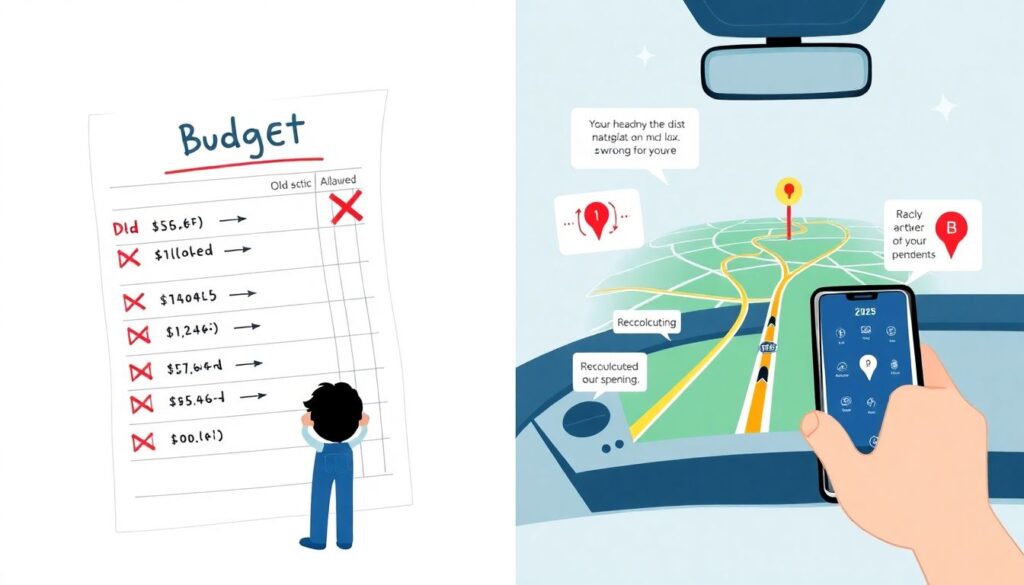
A lot of people still imagine a budget as a rigid list of categories that tells you what you’re “not allowed” to do. That definition is outdated. In 2025, a working budget is closer to a navigation system: it constantly recalculates when you take a wrong turn.
Instead of “I must stick to this sheet no matter what”, think: “This is my best current plan for the money I’ll have this month — and I’ll update it when reality hits.”
> Technical detail — Modern budget definition
> Budget = expected income (for a period) → assigned to specific jobs:
> – Survival (rent, food, bills)
> – Stability (debt payments, emergency fund)
> – Progress (education, business, investments)
> – Joy (fun, travel, hobbies)
>
> A budget is valid only when:
> 1. Every dollar has a job.
> 2. The numbers match your *real* income and bills.
> 3. You check and adjust at least weekly.
So your first realistic-year plan is not a one-time document. It’s a living system you iterate on for 12 months.
Step 2: Map Your “True” Income (Even If It’s Messy)
Budgeting fails most often because people overestimate how much they actually have. You might earn 3,000 a month on paper, but after tax, retirement contributions, health premiums, and the “mandatory” Uber Eats you never count, the real number is smaller.
For your first year, you want brutally honest numbers, not optimistic ones.
1. Open your banking app and export the last 3–6 months of transactions.
2. Look at how much money actually landed in your account each month after everything.
3. Calculate the *average*, then the *worst* month.
> Technical detail — Quick income baseline formula
> – Net monthly income (average of last 6 months) = Iₐ
> – Net monthly income (lowest month in 6 months) = Iₘᵢₙ
>
> For a realistic first-year budget, plan your fixed commitments (rent, utilities, subscriptions, minimum debt payments) using Iₘᵢₙ, not Iₐ.
>
> That way, your budget survives bad months, and good months become a bonus, not a rescue operation.
If your income is irregular (freelance, gig work), use your worst three months in the last year as the baseline. It will feel conservative, but it’s how you avoid panic when the algorithm or client pipeline flips on you.
Step 3: Track Reality for 30 Days Before You “Optimize”

A lot of “how to create a monthly budget from scratch” tutorials jump straight into category percentages — 50/30/20, 70/20/10, etc. Those are fine as rough frameworks, but your first realistic year needs to start with observation, not control.
For the next 30 days, don’t try to be perfect. Just track *everything* automatically.
In 2025 you don’t need to keep a notebook in your pocket:
– Connect your main accounts and cards to 1–2 apps.
– Let them pull your transactions and auto‑categorize.
– Correct categories once a week — that’s it.
This 30‑day snapshot is your real baseline: how you naturally behave with money when nobody’s watching. Your job is not to judge it, just to see it clearly.
Step 4: Use Tech Smartly — Apps That Work for Beginners in 2025
Ten years ago, a spreadsheet was your main option. Today, the best budgeting apps for new budgeters behave more like fitness trackers: they nudge, visualize, and automate, but they don’t make decisions for you.
Look for apps that:
– Sync automatically with your bank in your country.
– Offer category rules (“Groceries” vs “Eating out”).
– Show trends (e.g., “Your subscriptions grew 18% this year”).
– Have clear weekly summaries and alerts, not just dashboards.
If you want structure and accountability, you can even treat a personal budget planner for beginners inside an app like a mini-coach: start with their default categories and prompts, then delete what doesn’t match your life.
> Technical detail — How many apps is too many?
> – Use 1 app as your *source of truth* (the place with all your accounts).
> – Optionally add 1 extra app for investing or side‑hustle tracking.
> – More than that, and you risk “tool hopping” instead of building habits.
>
> The limiting factor is not features; it’s your willingness to open the app 2–3 times a week and act on what you see.
Trends in 2025 show a shift toward automation plus human review: rules pay your bills and autofund savings, but you manually approve unusual or large expenses once a week. That balance keeps you engaged without burning you out.
Step 5: Build Your First 12-Month Framework (Not a Perfect Forecast)
This is where your step by step guide to budgeting your first year really starts to look like a plan.
You’re not going to predict 12 months of spending category by category. Instead, think in three layers:
1. Non‑negotiable survival: rent, utilities, minimal food, essential transport, medication.
2. Stability moves: debt minimums, emergency fund, insurances.
3. Variable lifestyle: everything else (subscriptions, takeout, travel, hobbies, gifts).
Now, for each month over the next year, ask three questions:
– Will income change? (holidays, bonuses, off‑season for your job)
– Are there known big expenses? (insurance renewals, tuition, birthdays, travel)
– Is there any planned “life event”? (moving, job change, starting a course)
Write those answers down in a simple 12‑line list — one line per month with the main events. That’s your annual risk map.
> Technical detail — Minimum annual cushion calculation
> Suppose:
> – Iₘᵢₙ (from earlier) = 2,000
> – Non‑negotiable survival = 1,300
> – Stability (debt minimums, basic insurance) = 300
>
> Your monthly must‑have = 1,600
>
> Target “shock absorber” for the year:
> – 2–3 months of must‑have expenses
> – So: 1,600 × 2 = 3,200 (bare minimum) to 1,600 × 3 = 4,800 (safer)
>
> Reaching this in 12 months requires saving:
> – 3,200 / 12 ≈ 270 per month (minimum)
> – 4,800 / 12 = 400 per month (ideal)
Those are concrete numbers you can test against your income and adjust. If 400/month is impossible, you don’t give up — you slide the goal to 18 months or 24 months and keep the same logic.
Step 6: Design a 4‑Category Starter Budget You’ll Actually Use
To avoid overwhelm, start your first realistic year with just four overarching categories and group everything under them:
1. Must Live
2. Must Protect Future
3. Nice to Have
4. Growth & Dreams
Here’s how to apply them in practice.
– Must Live: rent, utilities, groceries, basic transport, phone, internet.
– Must Protect Future: debt minimums, emergency fund, basic health and property insurance.
– Nice to Have: streaming, takeout, bars, impulse online buys, nonessential upgrades.
– Growth & Dreams: courses, business tools, travel, long-term investments.
In 2025, with rising living costs, a lot of people find their “Must Live” creep up year after year. The trick is to avoid silently expanding this category just because new subscriptions and “essential” apps appear. Every time you add a new monthly payment, ask: *Which category does this actually belong to?* If it’s “Nice to Have”, don’t let it masquerade as survival.
> Technical detail — Percentage guardrails
> For a first-year, realistic but disciplined setup:
> – Must Live: 45–60% of net income
> – Must Protect Future: 10–20%
> – Nice to Have: 10–25%
> – Growth & Dreams: 5–20%
>
> These ranges are descriptive, not prescriptive. Your job is to:
> 1. Calculate your current percentages.
> 2. Decide where you *want* them to be in 6–12 months.
> 3. Adjust by 1–3 percentage points at a time, not 20 at once.
This structure is simple enough to remember when you’re half‑asleep scrolling an online store: “Am I spending from Nice to Have or stealing from Protect Future?”
Step 7: Make Lifestyle Cuts That Survive a Whole Year
One of the biggest mistakes beginners make? Slashing all fun for 2–3 months, then binge‑spending out of frustration. The skill you’re building is not “maximum restriction”; it’s sustainability.
Use this 3‑level test for every potential cut:
1. Zero‑pain cuts (keep forever)
– Free trial you forgot to cancel.
– Subscription you genuinely don’t use.
– Insurance overlap, duplicate services.
2. Medium‑pain cuts (test for 90 days)
– Halving food delivery.
– Downgrading phone/streaming plans.
– Swapping 2 paid rides per week for public transport.
3. High‑pain cuts (avoid unless emergency)
– Cutting all social life spending.
– Severely underfunding groceries or health.
– Skipping essential insurances.
Your target for the first year is to exhaust all zero‑pain cuts and run a few medium‑pain experiments, not to jump straight into high‑pain territory. That way your budget feels tight but livable, rather than a punishment you rebel against.
Step 8: Weekly Money Rituals — the Habit That Actually Changes Everything

The modern trend isn’t “set a budget in January and hope”. It’s lightweight weekly reviews. Ten years ago, that would have sounded tedious; in 2025, you can do most of it on your phone in 15 minutes.
Once a week, ideally the same day:
– Open your budgeting app.
– Check: categories that are close to overspending.
– Move money between categories if priorities changed.
– Confirm any unusual or large transactions.
Think of it like cleaning your kitchen once a week instead of waiting for a disaster.
> Technical detail — The 15-minute weekly checklist
> 1. Reconcile: all accounts match the bank (no unknown transactions).
> 2. Review categories:
> – Any category above 80% used, but month not over?
> – Any category with a surplus you can reassign?
> 3. Re‑prioritize:
> – Move surplus from Nice to Have → Protect Future or Growth & Dreams.
> 4. Micro decision:
> – Choose *one* thing this week to slightly reduce (e.g., 1 fewer delivery).
This is where your budget stops being theoretical. Week by week, you see how small nudges add up into hundreds or thousands saved over the year.
Step 9: Plan for Big 2025-Specific Budget Traps
Your first realistic year doesn’t happen in a vacuum. It’s happening in 2025, with its own “normal” money traps:
– Subscriptions everywhere: news, AI tools, design apps, games, gyms, cloud storage.
– Buy Now, Pay Later (BNPL): makes purchases feel cheap, but stacks future obligations.
– Micro‑transactions: in apps, games, SaaS upgrades.
– Social pressure spending: “everyone is going to that festival / retreat / conference.”
For each of these, set a *hardened rule* in advance. For example:
– Max 3–5 recurring paid subscriptions per person.
– No BNPL for anything that isn’t essential and stable (e.g., maybe a laptop for work, but not clothes or concert tickets).
– Monthly “impulse cap” — once you hit it, you wait until next month.
– A set annual cap on “events and festivals” — once spent, you say “no” guilt‑free.
These rules act as guardrails when your energy or willpower are low. You’re not deciding in the moment; you’re following a pre‑agreed contract with yourself.
Step 10: Use Education Strategically (Without Drowning in Content)
Because money anxiety is so widespread, there’s now an explosion of resources: blogs, YouTube, podcasts, TikToks, and every type of beginner budgeting course online you can imagine. Information is no longer the bottleneck — implementation is.
A simple rule for your first year:
– For every hour you spend consuming content, spend 30 minutes doing something practical with your own numbers.
Examples:
– Watch one video on investments → Actually open your broker app and set up a small recurring purchase.
– Read a blog on side hustles → List 3 skills you can sell and pitch one client.
– Take a course on budgeting → Build and fill in your own 4‑category setup on the same day.
This ratio keeps you from becoming “financially overeducated but under‑changed” — a surprisingly common 2025 phenomenon.
Case Study: A Realistic First Year for a 25-Year-Old in 2025
Imagine Alex, 25, lives in a mid‑size city, works in tech support.
– Net income: 2,400/month.
– Rent + utilities: 950.
– Student loan minimum: 150.
– Transport: 120.
– Groceries: 300.
– Subscriptions + “digital life”: 120.
– Random eating out: averages 250.
At the start of the year, Alex does the 30‑day tracking exercise and discovers:
– Total “Nice to Have” spending (food delivery, drinks, impulse online buys) is ~450/month.
– No emergency fund.
– Credit card balance: 1,800 at 22% interest.
Alex sets this 12‑month plan:
1. Trim subscriptions from 120 → 70 by canceling old trials.
2. Cap “Nice to Have” at 300/month (a 150 cut, mostly from food delivery).
3. Direct extra 150 + 50 from subscriptions = 200/month toward the credit card until it’s gone.
4. Once the card is cleared (around month 10 with interest), redirect the 200 to emergency savings.
By the end of year one:
– Credit card: 0.
– Emergency fund: ~400 (last two months’ 200).
– Monthly habits: weekly review, 4‑category budget, lower friction with money decisions.
This is not glamorous. But it’s the kind of slow, realistic progress that compounds over the next five years.
Putting It All Together: Your First Realistic Year Blueprint
Here’s a compact way to think about your next 12 months with money:
1. Observe before controlling: track one month as you are.
2. Anchor to worst‑case income, not your best.
3. Use one main app as your personal command center.
4. Organize into four categories, not twenty.
5. Cut zero‑pain first, test medium‑pain; avoid extreme cuts.
6. Do a 15‑minute weekly review — non‑negotiable.
7. Pre‑decide rules for subscriptions, BNPL, and events.
8. Balance learning with doing in a 2:1 ratio.
You don’t need the perfect tool, the perfect personal budget planner for beginners, or the perfect plan from day one. You need a system you will actually touch every week, a set of numbers that reflect your real life, and enough flexibility to adapt when — not if — things change.
Your first realistic year of budgeting is not about becoming a different person. It’s about making the person you already are just 10–20% more intentional with every paycheck. Over twelve months, that “small” shift is what changes everything.