Understanding Why Strategy Matters More Than Motivation
When you’re staring at a pile of balances, it’s tempting to just “pay more” and hope for the best. The issue is that without a clear system, extra money gets scattered, interest keeps compounding, and progress feels invisible. That’s why choosing the best debt payoff strategy is less about willpower and more about using a repeatable method. Both the debt snowball and debt avalanche give structure: which debt to hit first, how much to pay, and how to react when a balance disappears. Behavioral finance research shows that a simple visual sense of progress can increase follow‑through more than abstract savings in interest, so the “right” choice depends not only on math, but on how your brain handles wins and setbacks.
Debt Snowball: How It Works in Real Life
Core Idea of the Snowball Method
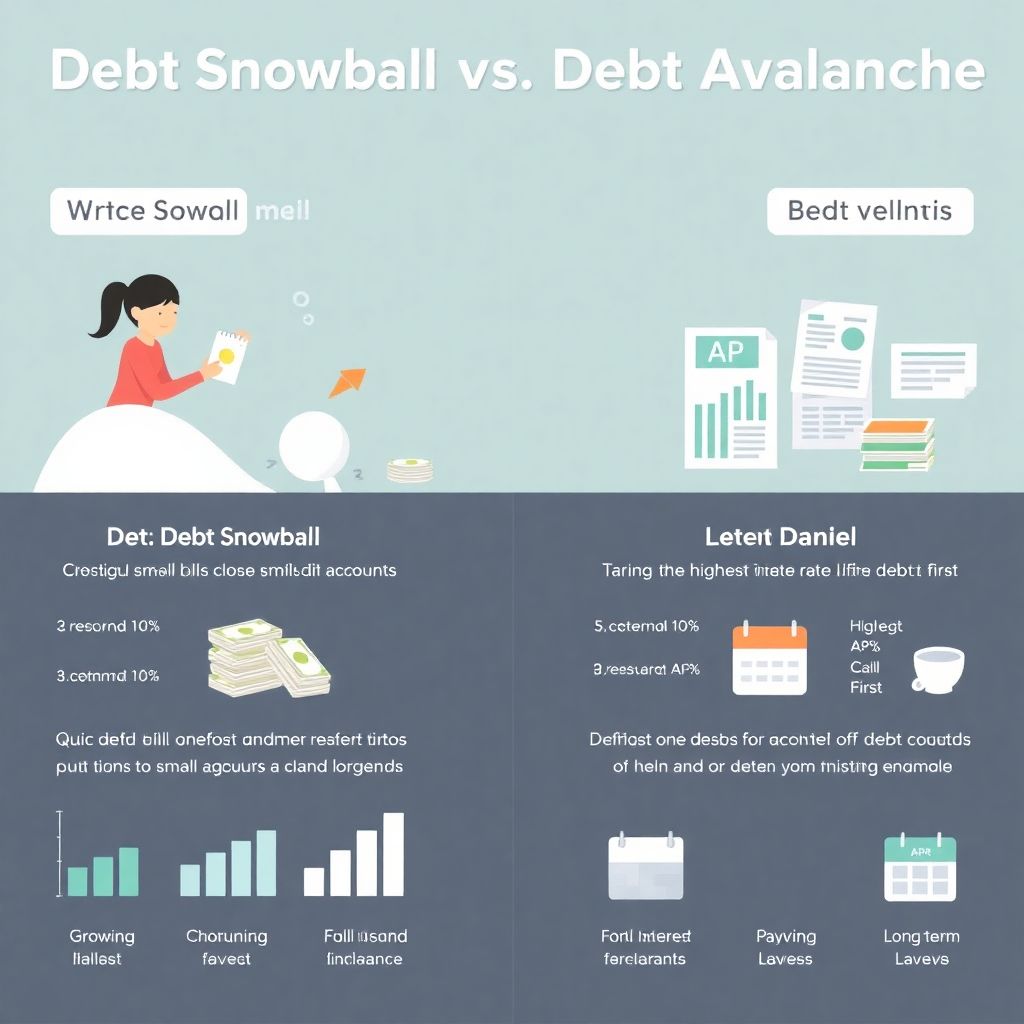
The debt snowball focuses on psychological momentum. You list debts from the smallest balance to the largest, ignore interest rates at first, and attack the tiniest one with every extra dollar while paying minimums on the rest. Once that first balance hits zero, you roll its entire payment into the next smallest debt, so your total payment grows like a snowball. People who struggle with motivation often find this method surprisingly powerful, because they see quick wins on their statement. Instead of feeling like you’re bailing out an ocean with a spoon, you actually close accounts and shrink the number of bills you juggle each month.
> Technical block – Snowball sequence
> 1. List all debts by balance (ascending).
> 2. Pay minimums on all, except the smallest.
> 3. Throw every extra dollar at the smallest.
> 4. When it’s gone, add that full payment amount to the next debt.
> 5. Repeat until all balances are zero.
Example: The “I Need a Win Fast” Scenario
Imagine Mia, who has three debts: a $700 store card at 24% APR, a $3,200 credit card at 19% APR, and a $9,000 car loan at 8% APR. After covering essentials, she can send $450 per month to debt. With the snowball, she targets the $700 store card first. She pays $250 there and minimums on the others. In four months the store card disappears, and that entire $250 shifts to the $3,200 card, instantly raising its payment from about $100 to $350. Within a year, Mia has wiped out two accounts and only the car loan remains. The total interest isn’t minimal, but emotionally she goes from three payments to one in about 14 months, which keeps her locked in.
Debt Avalanche: The Math-First Approach
How the Avalanche Method Prioritizes Interest
The debt avalanche flips the order: you list debts by interest rate, from highest APR to lowest, and channel all your extra cash to the most expensive one first. Mathematically, this approach almost always wins the debt snowball vs debt avalanche comparison on total interest paid and often on total payoff time, assuming your payments are consistent. The avalanche doesn’t care about balance size; a $9,000 loan at 25% APR jumps ahead of a $600 card at 14%. Over multi‑year horizons this can mean thousands saved, especially with aggressive credit cards. For analytically minded people who are comfortable waiting longer for that first “paid in full” letter, the avalanche is usually the most efficient.
> Technical block – Avalanche sequence
> 1. List all debts by APR (descending).
> 2. Pay minimums on all except the highest APR.
> 3. Direct every extra dollar to that high‑rate debt.
> 4. When it’s gone, move to the next highest APR.
> 5. Continue until every balance reaches zero.
Example: Saving Thousands with the Avalanche
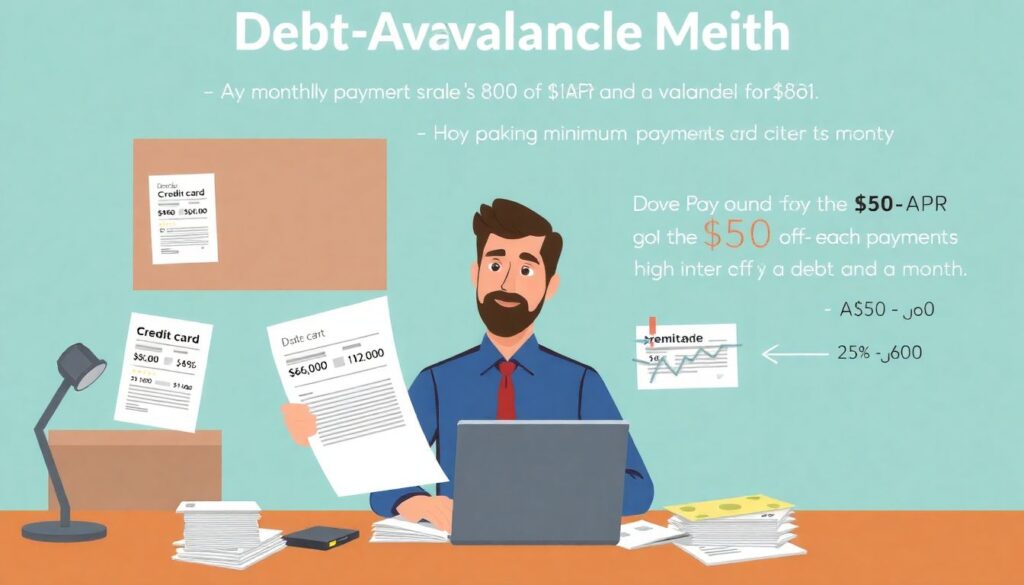
Take Daniel, carrying $6,000 on a card at 26% APR, $4,500 on another at 18%, and a $12,000 personal loan at 10%. He can pay $800 per month. If he uses the avalanche, he hits the 26% card first. With minimums on the rest, roughly $550–$600 goes straight to this card, knocking it out in a little over a year. Then that freed‑up payment crushes the 18% card, which falls in another eight months, and lastly the 10% loan. When we run the numbers, Daniel saves roughly $2,500–$3,000 in interest over the life of the plan compared with snowballing the smallest balance first, even though the total payoff time differs by only a few months.
Snowball vs Avalanche: Behavioral vs Mathematical Win
The Core Trade-Off Between the Two
From a pure numbers standpoint, the avalanche is usually the best debt payoff strategy, because the highest interest rate is your most expensive enemy. But humans aren’t spreadsheets. Many studies and real‑world case files from financial coaches show that people frequently abandon a technically superior plan if they don’t feel progress early. The debt snowball tackles that problem by serving quick emotional victories. Every time you close an account, it reinforces the habit of sending a big lump sum to debt. The trade‑off is clear: snowball improves adherence and reduces perceived stress, avalanche optimizes for total cost. The “wrong” method you can stick with consistently beats the “perfect” method you quit halfway.
Real Case: When Each Method Fails
Consider two clients from the same coaching firm. Anna chose the avalanche, but her highest‑interest debt was a large loan that would take 18 months to clear. After nine months of grinding with no accounts closed and balances barely looking smaller, she cut her extra payments to cover lifestyle upgrades and eventually stalled out. In contrast, Omar picked the snowball. He cleared three tiny balances in his first six months but then refused to adjust his budget once the easy wins were gone, keeping big discretionary spending. Both technically had solid plans, yet each method exposed their specific behavioral weak spots. Matching method to personality and discipline level matters more than perfect math.
Using Calculators and Projections to Decide
Why You Should Model Both Paths
Before committing, it’s smart to quantify the trade‑off instead of guessing. A debt repayment calculator snowball avalanche comparison allows you to plug in balances, APRs, and monthly payment capacity to see timelines and interest totals side by side. When clients see that the avalanche might save, for instance, $1,100 over four years compared with the snowball, many decide whether that savings is worth potentially slower early “wins.” Others discover the gap is only a couple of hundred dollars, and then shift decisively toward whatever feels more sustainable. Turning vague fear into a clear schedule—month‑by‑month projected balances—removes a lot of anxiety and makes the choice more rational.
> Technical block – Key metrics to compare
> • Total interest paid under each method.
> • Months until first debt is paid off.
> • Total months until debt‑free.
> • Monthly cash‑flow freed as each debt dies.
> • Sensitivity: what happens if you add +$50 or +$100 per month?
Example Calculation: Same Debts, Different Outcomes
Let’s say you owe $18,000 spread over four credit lines at rates from 9% to 25%, and you can pay $700 monthly. When we model a snowball, you might become debt‑free in about 34 months, paying around $6,200 in interest. The avalanche might shorten that to 32 months with roughly $4,900 in interest. That’s a 2‑month difference and $1,300 saved. For someone disciplined, that’s an obvious reason to pick avalanche. For someone who has started and stopped five plans already, the psychological security of dramatically fewer accounts in year one can be worth that $1,300. Seeing explicit numbers gives you permission to choose based on both head and gut.
How to Pay Off Credit Card Debt Fast in Practice
Boosting the Plan Beyond Just “Method”
Whether you pick snowball or avalanche, your speed largely depends on how much extra cash you can throw at principal. Expert coaches emphasize three levers: reducing fixed expenses, temporarily capping lifestyle upgrades, and increasing income for a defined window. For example, trimming $150 from subscriptions and renegotiating insurance, plus picking up one weekend shift that nets $200, can add $350 monthly to debt payments. Over two years that’s over $8,000 in principal destroyed, regardless of method. The strategy is the blueprint, but the pay‑off velocity comes from widening the gap between income and spending and then protecting that gap like a non‑negotiable bill.
Preventing Relapse While You Accelerate
Speed without stability can backfire. Many people rush to pay off credit cards, then face a car repair or medical bill and re‑swipe the same cards. To truly figure out how to pay off credit card debt fast without boomeranging, advisors recommend building a small starter emergency fund—often $500–$1,000—before going all‑in on the snowball or avalanche. That cushion absorbs routine surprises so you’re not undoing progress. Next, freeze new card spending except for pre‑planned, fully budgeted transactions you repay in the same month. This combination of a basic buffer and stricter card rules keeps your payoff strategy from turning into a frustrating cycle.
When It Makes Sense to Hire a Financial Coach
Role of a Coach in Choosing and Sticking to a Method

If you’ve tried both methods on paper and still feel stuck, it may be time to hire financial coach for debt payoff support. A good coach doesn’t just tell you “avalanche is better” or “snowball is easier”; they review pay stubs, billing cycles, your temperament under stress, and even how your partner handles money. They’ll spot patterns like chronic overspending the week after payday or anxiety that leads to retail therapy. Then they design a payoff system with guardrails: automatic transfers, accountability check‑ins, and clear rules for windfalls. Their value isn’t in the arithmetic; it’s in keeping you from abandoning a sound plan when life inevitably gets noisy.
What Expert Coaches Actually Recommend
Seasoned debt specialists rarely push a single “correct” method. One CFP I interviewed summarized her approach this way: “If a client is detail‑oriented, stable in their job, and comfortable waiting for a win, I default to avalanche. If they’re overwhelmed, ashamed, or have a history of quitting, I start with snowball.” Another coach blends them: he orders debts by interest rate, but if two are close, he prioritizes the smaller balance for a quick psychological boost. The consensus among professionals is simple: the best plan is the one you will execute relentlessly for 24–48 months, not the one that looks prettiest in a spreadsheet.
Blended and Advanced Strategies for Complex Situations
Hybrid Approaches: Getting the Best of Both Worlds
You’re not locked into a pure snowball or pure avalanche. Many experts encourage hybrid structures. One common version: start with a mini‑snowball on two or three smallest accounts to declutter your finances quickly, then switch to avalanche on the remaining larger debts. Another variation is to use avalanche for all non‑negotiable debts while manually inserting one “quick win” target every six to nine months to refresh motivation. This flexible mindset respects both math and behavior. It also adapts to life changes; if your income jumps or you receive a bonus, you can temporarily shift to a strict avalanche sprint to maximize interest savings, then ease back into a more psychologically supportive order.
> Technical block – Building a hybrid plan
> 1. Classify debts: tiny/medium/large; high/medium/low APR.
> 2. Clear 1–3 tiny debts first for morale.
> 3. Re‑rank remaining by APR for avalanche.
> 4. Every 6–9 months, reassess balances and income.
> 5. Adjust target order if motivation or cash‑flow shifts.
Dealing with Special Debts and Risk
Not all debts behave the same. Tax debts, support obligations, and certain government loans carry legal risks that trump interest considerations. Expert guidance is to prioritize any debt that can trigger wage garnishment, liens, or legal action, even if its APR is low. Similarly, if one debt is in collections with aggressive contact or at risk of lawsuit, it may need to jump the queue ahead of your ideal snowball or avalanche ordering. In practice this means building a “compliance layer” first—ensuring you’re safe from legal consequences—then applying your chosen payoff method to the remaining consumer debts. Ignoring this layer is one of the most dangerous blind spots in DIY payoff plans.
How to Choose: A Simple Decision Framework
Matching the Method to Your Personality and History
To decide between debt snowball vs debt avalanche, look back at your own track record. If you’re the kind of person who finishes long projects, follows through on workout plans, and enjoys optimizing details, the avalanche will likely reward your discipline with lower costs. If, instead, you have a history of strong starts and weak finishes, or debt makes you feel paralyzed and ashamed, snowball’s rapid wins can be a lifeline. Ask yourself: “Will I still do this after six boring months?” If the honest answer is “only if I see results quickly,” lean toward snowball or a hybrid. This self‑awareness is more predictive than any formula.
Putting Your Choice into Action This Week
Once you’ve chosen, the most important step is to turn the idea into automation. Set up automatic payments: minimums on all debts plus a fixed extra amount on your chosen target. Schedule this for the day after payday so you’re never tempted to “borrow” from your payoff money. Revisit your plan monthly for the first three months, then quarterly. If your income changes by more than 10%, or a major life event hits, rerun your numbers through a calculator and adjust. The goal is not perfection but consistency: a clear, rules‑based system that keeps crushing balances even when you’re tired, busy, or emotionally drained.
Final Thoughts: Your Strategy Is a Tool, Not an Identity
Whether you end up a snowball loyalist, an avalanche purist, or somewhere in between, remember that these methods are tools, not ideologies. You’re allowed to switch if your first choice isn’t working, as long as you’re honest about why. If you notice yourself paying less or skipping months, it’s a signal to reevaluate—not a personal failure. The real victory isn’t choosing the “smartest” technique; it’s reaching a point where interest is no longer dictating your life choices. Pick a strategy that fits your brain, automate it as much as possible, and give it enough time to work. Over a few focused years, the compounding effect of consistent payments will do the heavy lifting for you.