Money basics in 2025: why this suddenly matters
If you feel that money used to be simpler, you’re not imagining it. Until the late 20th century, most people had one paycheck, a pension, and a savings account; credit cards were rare, investing was for a small minority, and financial products were limited. Fast‑forward to 2025: we juggle subscriptions, buy‑now‑pay‑later, online brokers, crypto remnants after the 2021–2022 boom‑and‑bust, and endless “side hustle” advice. According to the OECD, financial literacy levels have barely improved in a decade, while retail participation in markets has surged since the pandemic. That gap between complexity and knowledge is exactly where a simple beginners’ guide to personal finance has real economic value: it lowers the odds of costly mistakes, stabilizes household budgets, and reduces the stress that quietly drags down productivity and long‑term wellbeing.
Personal finance, in other words, has become a life skill on par with digital literacy, not a niche hobby for spreadsheet fans.
How we got here: a short history of personal finance
Modern personal finance has roots in the 1970s–1980s, when inflation, deregulation, and the rise of index funds changed how households interacted with money. In the 1990s, 401(k)‑style plans and the shift away from defined‑benefit pensions pushed investment risk from employers to individuals. The 2008 crisis exposed how little many people understood about adjustable mortgages and leverage, while the 2020 pandemic showed both the fragility and resilience of household finances: savings briefly spiked from lockdowns and stimulus, then eroded under inflation by 2022–2023. Each wave reinforced the same lesson: when systems become more market‑driven, individuals need clearer playbooks. By 2025, that historical arc explains why demand for every personal finance for beginners course, podcast, and YouTube channel keeps rising: people are trying to catch up with a system that outsourced risk to them without handing over the instruction manual.
The core framework: earn, spend, protect, grow
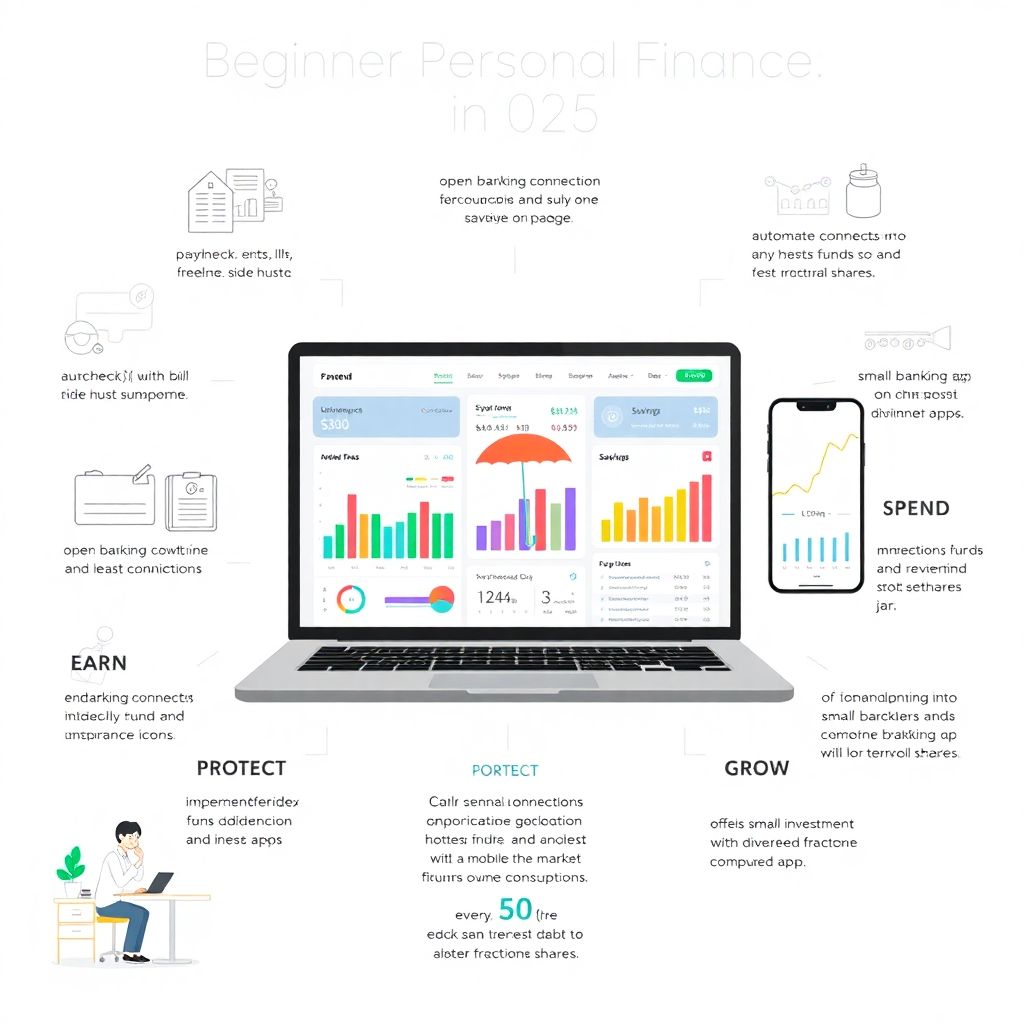
A simple but robust framework for beginners has four pillars: earn, spend, protect, grow. Earnings include salary, freelance work, and occasionally passive income; spending covers fixed costs, flexible choices, and debt. “Protect” means emergency funds and insurance, while “grow” deals with investing and retirement. This might sound obvious, yet surveys in the US and EU still find that a large share of adults cannot correctly answer three basic questions on interest, inflation, and risk diversification. Without a structure, people react to money rather than plan around it, especially when pushed by social media trends. By organizing your decisions into these four buckets, you impose order on a chaotic environment and make it easier to evaluate tools: a budgeting app belongs to “spend,” index funds belong to “grow,” and so on. The clarity is what makes the system sustainable under real‑life stress.
Think of this as a mental dashboard, not a rigid rulebook.
Budgeting in the app era: data instead of guilt
Budgeting used to mean envelopes and notebooks; today, it’s APIs and notifications. That shift is not just cosmetic. When your card, bank, and digital wallet transactions flow into a single interface, you get something households never had at scale before: near real‑time cash‑flow analytics. The best budgeting apps for beginners do three economically important things: they categorize spending automatically, they forecast upcoming bills based on history, and they visualize trends in a way that makes trade‑offs obvious. Macroeconomically, millions of people smoothing their consumption with better planning slightly stabilizes demand, while at the micro level it reduces overdraft fees and high‑interest borrowing. Regulators in several regions have pushed “open banking” specifically to enable this ecosystem. The result is that in 2025, ignoring your numbers is more a behavioral choice than a technological limitation.
The challenge is not access to tools, but building the weekly habit to look at them.
How to start investing with little money in a noisy market

The rise of zero‑commission brokerages and fractional shares solved a historic barrier: high minimums. Now the question is not access but discipline. When you ask how to start investing with little money in 2025, the economically sound answer is boring: automate small, regular contributions into diversified, low‑cost funds, and ignore most short‑term noise. After the meme‑stock and crypto cycles, data from multiple markets show that frequent traders underperform simple index strategies once fees and poor timing are accounted for. Meanwhile, global equity markets, despite volatility, have historically rewarded long‑term, diversified investors. For beginners, the crucial economic insight is that time in the market beats trying to predict it: compounding from starting at 25 instead of 35 can be worth hundreds of thousands by retirement, even at modest contribution levels. Technology removed the gatekeepers; what remains is the need for a clear, evidence‑based playbook.
In practice, “little money” is enough, provided you give it enough years.
Debt, inflation, and the invisible costs of bad timing
Debt is where personal choices intersect most painfully with macroeconomics. In the high‑inflation years after 2021, real wages in many countries struggled to keep up with prices, pushing households toward credit cards and buy‑now‑pay‑later options. Central banks then raised rates, making new borrowing more expensive. The result by 2024: a squeeze on anyone carrying variable‑rate debt. For beginners, the analytical move is to rank obligations not emotionally but mathematically: focus on the highest interest rate first, while keeping minimums on the rest, and avoid adding new high‑cost debt for non‑essentials. Economists worry because heavily indebted households cut consumption faster during downturns, amplifying recessions. On a personal level, interest is simply the price of impatience; every month you carry a balance, you transfer part of your future flexibility to a bank’s income statement instead of your own net worth.
Paying down toxic debt is, effectively, a risk‑free “investment” at that interest rate.
Education boom: from books to online coaching
The surge in financial uncertainty has created its own industry. Search data and enrollment numbers show strong growth in every type of personal finance education, from a self‑paced personal finance for beginners course to live bootcamps and TikTok explainers. Alongside that, demand for online personal finance coaching for beginners has risen as people seek customized guidance rather than generic tips. This has economic side effects: better‑informed consumers question high‑fee products, pushing traditional financial institutions to simplify offerings and cut costs, while new fintech players build business models around transparency and subscription pricing. The risk, of course, is that low‑barrier online content can mix evidence‑based advice with hype, especially around speculative assets. For learners, the rational approach is to treat all influencers as marketers until proven otherwise and to favor sources that disclose conflicts of interest and show actual methodologies, not just success stories.
Trust processes and incentives more than personalities.
Books, courses, and where the money flows next
Despite the online shift, print and digital titles remain powerful. Publishers report that “money and investing” remains one of the most resilient non‑fiction categories, and there is no shortage of personal finance books for beginners to buy in 2025. The best of them combine behavioral insights with plain arithmetic, helping readers translate abstract concepts like “risk tolerance” into concrete asset allocations and savings targets. Economically, each well‑informed reader is a slightly more efficient allocator of capital and less vulnerable to predatory schemes, which, scaled across millions, nudges markets toward healthier dynamics. Over the next five years, expect further blending of media: books tied to interactive tools, a personal finance for beginners course bundled with budgeting software, and AI‑driven coaching layered on top. Forecasts for the global fintech and financial‑education market point to double‑digit annual growth, as demographic shifts and remote work keep reshaping how, and where, financial decisions get made.
The common thread is personalization built on cheap data and powerful algorithms.
From individual choices to industry‑wide change

When enough beginners make slightly better financial decisions—saving a bit more, trading less, avoiding high‑fee products—the impact doesn’t stay personal. Asset managers respond to flows by cutting expense ratios; banks rethink overdraft policies when fee revenues fall; regulators adjust disclosure rules when retail investors become a meaningful voting bloc in corporate governance. The post‑2020 rise of small investors in shareholder meetings already pushed some firms to explain strategies in plainer language. As we move through 2025, the feedback loop tightens: technology empowers individuals, collective behavior pressures institutions, and new regulation then reshapes the tools available to the next wave of beginners. Starting simple with your own finances is not just self‑help; it is, in aggregate, one of the quieter forces redirecting capital and risk across the global economy.
Your first budget or investment might feel trivial, but statistically, you are part of a structural shift.