
Why Starting with Just $50 Actually Works

Starting to invest with only fifty bucks sounds like a meme, but it’s absolutely viable in 2025. Fractional shares, zero-commission brokers and beginner investment apps with low minimum have killed the old idea that you need thousands to play. The real challenge isn’t the amount of cash, it’s building the habit, understanding risk and avoiding dumb moves like chasing hype. If you’re wondering how to start investing with little money, think of $50 as tuition: you’re buying real-world experience with limited downside. Professionals emphasize that your first goal isn’t to “get rich”; it’s to learn the mechanics—orders, diversification, fees, taxes—while protecting yourself from catastrophic mistakes.
Mindset: Treat $50 Like a Training Budget
Before opening any account, lock in your mental model. This $50 is not for rent money, emergency bills or short‑term goals. Experts call this “risk capital”: funds you can lose without wrecking your life. That frame lets you think clearly instead of panicking with every market swing. Set a basic time horizon of at least 3–5 years and accept volatility as normal noise, not a sign you’re failing. Mentors who coach young investors repeat the same point: your edge isn’t stock‑picking genius, it’s discipline, small consistent contributions and the ability to stay invested while everyone else reacts emotionally to headlines and social media drama.
Essential Tools You Need to Get Started
Brokerage Account and App
Your central instrument is a regulated brokerage account that lets you buy stocks, ETFs and sometimes bonds or crypto. For someone asking how to invest 50 dollars for beginners, the screening criteria are simple: zero trading commissions, no account maintenance fee and the ability to buy fractional shares. That combination means your entire $50 actually goes to assets instead of charges. Look for intuitive interfaces with clear order tickets (market, limit, recurring buys) and in‑app education. Many brokers also offer automatic dividend reinvestment, which converts small cash payouts into additional fractional shares and accelerates compounding over time.
Banking, Identity and Safety Basics
To fund your account, you need a checking account or a digital wallet that can link to the broker. Expect to provide legal name, tax ID and proof of address; this is normal KYC/AML compliance, not spying. Use unique passwords and enable two‑factor authentication—treat your brokerage like online banking, not a random app. Serious advisors also recommend turning on trade confirmations and account alerts so you immediately see any activity. Keep your login credentials off shared devices, and never authorize remote screen‑sharing with strangers offering “investment help”. Solid security hygiene matters as much as choosing the right ETF, especially when your skills are still developing.
Basic Research and Tracking Tools
You don’t need a Bloomberg terminal, but you do need objective information. Free screeners from major financial sites provide real‑time quotes, ETF descriptions, expense ratios and historical charts. Start by reading ETF factsheets rather than random forum threads; documents like the prospectus outline holdings, index methodology and risk factors in standardized language. For tracking, use a simple portfolio app or even a spreadsheet to log each contribution, asset, and date. This habit turns vague impressions into data: you’ll see how often you invest, how dividends accrue and how your mix of assets shifts. Professionals call this “performance attribution”, and even a simplified version will sharpen your decision‑making.
Step‑by‑Step: How to Deploy Your First $50
Step 1: Define a Simple Goal and Risk Level
Before placing any order, decide what this money is trying to do. Is the priority learning mechanics, long‑term wealth building, or both? For most beginners, advisors propose a “core–satellite” model, even at tiny scale: a diversified ETF core plus optional small positions in individual stocks. Clarify your risk comfort: if a 20% price drop would make you rage‑quit, lean toward broad, low‑volatility funds. Writing down one sentence—“This $50 is the first brick in a long‑term portfolio I’ll add to monthly”—seems trivial, but it gives you a benchmark when markets inevitably wobble and your emotions start negotiating against your plan.
Step 2: Choose the Right Type of Investment
When experts discuss the best investments for beginners with small amounts, they almost always highlight broad‑market ETFs and index funds. With one product, you buy tiny slices of hundreds or thousands of companies, reducing single‑stock risk. If your $50 is going into U.S. equities, a total‑market or S&P 500 ETF is a classic starting point. For more global diversification, add an international equity ETF once your balance grows. While it’s tempting to chase trending names, keep speculative single stocks to a small fraction of your capital until you’ve built a stable core; concentration risk is brutal when your analysis skills are still forming.
Step 3: Open and Fund Your Account
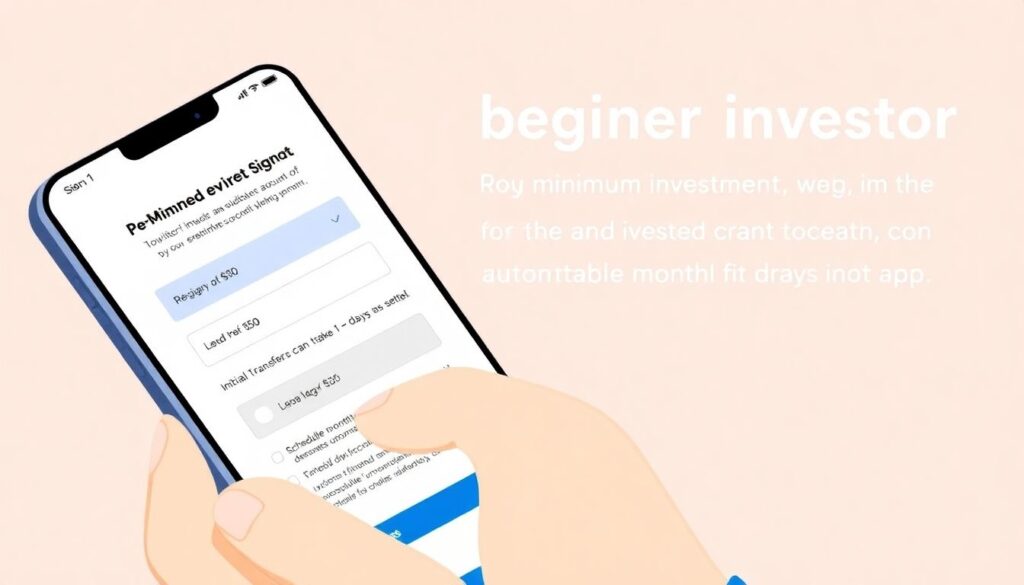
Now execute. Download a reputable broker offering beginner investment apps with low minimum, complete signup, and verify your identity. Link your bank and transfer your $50; initial transfers can take a day or two to settle. Many platforms let you schedule automatic monthly deposits—even $10 or $20—creating a “dollar‑cost averaging” stream that reduces timing risk. In settings, enable dividend reinvestment and recurring buys into your chosen ETF so the default behavior is automated discipline. Professionals view automation as a behavioral firewall: it protects your strategy from your own procrastination, mood swings and temptation to time the market based on short‑term news.
Step 4: Place Your First Order
To demonstrate how to start investing in stocks with $50, choose a broad ETF and use a fractional share order. In the app, select the ticker, tap “Buy”, then choose “By dollar amount” and enter $50 (or a portion). For small long‑term positions, a simple market order during regular trading hours is fine; the tiny spread is negligible at this scale. Confirm the order details before submitting. Once executed, ignore minor price wiggles in the first days. Instead, explore your position screen, read the fund’s description and note how many companies you indirectly own. You’ve shifted from observer to market participant, which changes how you absorb financial information.
Scaling Up: Turning $50 into a Habit
Automate Contributions and Upgrades
One isolated $50 investment is symbolic; a repeated $50 becomes powerful. Set a recurring transfer aligned with your payday so funding your account feels like a fixed bill, not an optional extra. As your income grows, increase the automated amount in small increments; this exploits lifestyle creep in your favor. Experts recommend a simple progression: maintain a diversified ETF core until you’ve hit a few hundred dollars, then consider adding a second asset class, such as bonds or REITs, to adjust risk. Keep changes infrequent and intentional. Constantly tinkering with a tiny portfolio usually reflects anxiety, not strategy refinement.
Track Performance Without Obsessing
Monitoring is essential, but refreshing your app every 15 minutes is not analysis, it’s self‑torture. Pick a cadence—monthly or quarterly—where you review your portfolio, contributions and allocation. Check whether your asset mix still matches your original risk level and horizon. If one holding grows to dominate, rebalance with new contributions rather than constant selling to avoid unnecessary taxes and friction. Veteran investors suggest maintaining a simple journal: log major decisions, your reasoning and market context. Over time, patterns will emerge in your behavior, revealing whether you’re prone to fear‑selling, chasing winners or ignoring concentration risk.
Troubleshooting: Common Problems and Fixes
“I Only Have $50 Once, Not Every Month”
Irregular income is normal, especially for students or gig workers. Even if you can’t commit to steady contributions yet, that first $50 still teaches the full investment workflow—account setup, funding, order placement, and tracking. Use this period to build knowledge instead of size: study basic portfolio theory, tax rules in your country and fee structures. Then, whenever extra cash appears, you already have the framework ready. Seasoned planners advise adopting a percentage rule instead of a fixed number: for example, invest 10% of any unexpected money (bonus, side job, gift), even if that’s just another $15 here and there.
“The Market Dropped and I’m Freaking Out”
Seeing your $50 turn into $43 can feel like failure, but volatility is not a bug, it’s the price of admission. Professionals recommend pre‑defining a “panic protocol”: steps you follow when markets jump or crash. That might include revisiting your written goal, checking long‑term charts and reminding yourself that broad indexes have historically recovered from every major drawdown given enough time. If a small dip triggers intense stress, treat it as data about your true risk tolerance, not a reason to abandon investing altogether. Adjust your allocation gradually toward more conservative assets rather than fleeing to cash in a single emotional move.
“Everything Seems Too Complicated”
The finance world loves jargon, which can make how to start investing with little money feel like decoding a foreign language. When you hit a concept that confuses you—expense ratios, bid‑ask spreads, rebalancing—break it into a concrete example with your actual $50. Ask, “How does this specific term change what happens to my account balance?” If it doesn’t, deprioritize it for now. Focus on core drivers: contribution rate, diversification, time in the market and total fees. Experts repeatedly emphasize that a simple, boring, low‑cost index strategy executed consistently beats most complex systems that new investors can’t stick with under stress.
“I Want to Pick Individual Stocks Already”
Curiosity about specific companies is healthy; it’s how you connect investing with the real economy. The danger is overconfidence on tiny data sets or TikTok‑level research. A compromise many professionals endorse is the “fun money cap”: keep at least 80–90% of your capital in diversified funds, and limit speculative single stocks to the remainder. Use that slice as a laboratory: write a mini‑thesis for each pick, define what success and failure look like and set a rough time horizon. This way, you can explore and learn security analysis while insulating your long‑term results from your inevitable early‑stage misjudgments.
Expert‑Backed Roadmap: From Noob to Intentional Investor
If you distill the advice from financial planners, portfolio managers and academics into something tailored to how to invest 50 dollars for beginners, the roadmap is surprisingly short. Start with a regulated broker that offers fractional shares and low‑cost index ETFs. Treat your first $50 as a training stake, not a lottery ticket. Automate contributions as your cash flow allows, prioritize diversification over stock tips, and document your decisions so you can learn from them. Over time, as your portfolio and knowledge compound together, the mechanics that once felt intimidating will become routine—and that’s the real point of starting small today.