
Why a Simple Budget Beats Endless Hustle
Most beginners think budgeting is about torturing yourself with spreadsheets. In reality, a simple, honest budget is just a map of how cash will move through your small business over the next 12 months. It answers three brutally practical questions: How much can I safely spend? When might I run out of cash? And what has to happen for this business to actually pay me a salary? If you ignore those questions, growth only масks problems — higher revenue, bigger stress, constant surprise bills. Owners who take budgeting seriously usually know, within a few hundred dollars, what their bank balance will be at the end of next month. That calm predictability is the real payoff, not some perfect Excel file.
When you’re learning how to create a budget for a new small business, think less about perfection and more about reducing the number of financial surprises each month.
—
Step 1. Define the Point of Your Budget (Not Just the Numbers)
Choose 2–3 decisions your budget must support
Before any math, decide what this budget has to help you decide. For a beginner, I recommend three priorities: 1) how much you can afford to pay yourself, 2) when (and if) you can hire help, and 3) how much you can safely spend on marketing without tanking your cash. Every line you add should connect to at least one of these decisions. For example, a café owner I worked with in Austin didn’t care about 30-row expense breakdowns. Her core question: “Can I open on Sundays and hire one more barista?” Once we framed the budget around that, she finally started tracking hourly labor costs and Sunday sales separately — and discovered Sunday was actually her most profitable day.
If a budget doesn’t clearly guide one of your next 3–6 big moves, it’s just financial decoration.
—
Translate goals into concrete financial targets
Now give those decisions numbers. Let’s say you want to pay yourself $3,000 a month within a year, keep at least one month of expenses in the bank, and invest $500–$800 per month into marketing. Those become your non‑negotiables. If the math later shows you can’t hit them yet, you don’t just “hope harder”; you adjust price, volume, or costs until the model works. Many owners skip this part and end up with “whatever is left” as a salary, which is how people burn out in year two. Your budget is allowed to say “No, not yet” to your plans — that’s a sign it’s working, not that you’re failing.
A simple test: can you summarize your budget’s targets in three sentences to a friend? If not, it’s too vague.
—
Step 2. Map Your Revenue Like an Analyst, Not a Dreamer
Estimate revenue using units, not vibes
The most common beginner mistake is “We’ll probably make around $10k a month.” That’s not a forecast; that’s a wish. Break revenue into units: number of clients, orders, or billable hours. For instance, a freelance designer might plan on 4 website projects a month at $1,500 each and 5 smaller logo jobs at $300. That’s $6,000 + $1,500 = $7,500 in projected revenue. Now you can stress‑test: What if you only close 3 websites? What if logos are slower? When a retail owner I advised in Berlin switched from “maybe €20,000 a month” to tracking average ticket size and daily foot traffic, he quickly spotted that rainy Mondays were killing his numbers and shifted a promo to those days, adding about 7% to monthly revenue.
Units are reality; round monthly guesses are just feelings with numbers attached.
—
Use conservative, realistic assumptions
For the first 12 months, build your budget with “pessimistic but reasonable” assumptions: maybe 70–80% of what you hope to achieve. If you expect 20 clients, budget for 14–16. If you aim for $200 average order value, test $160–$180 in your model. That way, overperformance becomes a safety buffer, not an excuse to increase spending. When I reviewed numbers for a small marketing agency, the owner had forecast $40k monthly revenue; the actual average was closer to $28k. Just lowering the forecast and matching expenses to that lower figure turned a scary cash‑burn situation into break‑even in three months.
If your budget only works under “perfect month” conditions, it’s not a plan — it’s fiction.
—
Step 3. List Expenses in Layers, Not Chaos
Separate fixed, variable, and “optional but useful” costs
For a clean, practical setup, structure your budget in three layers. Fixed costs: rent, software subscriptions, insurance, minimum loan payments — the bills that arrive even if you sell nothing. Variable costs: materials, packaging, payment processing fees, contractor hours that scale with work. Then “optionals”: marketing experiments, conferences, upgraded tools. A bakery owner I worked with listed “flour” and “sugar” correctly as variable, but had their delivery driver as “fixed” because it was a friend; once we tied that cost to actual delivery volume, their margins visibly improved as they batched deliveries instead of running daily.
Once your costs are grouped, you can decide what to cut in a slow month without panic — optional first, then some variables, fixed only as a last resort.
—
Anchor your numbers in real quotes, not guesses
In your first year, don’t trust “I think this will be about $200.” Collect actual quotes and contracts. Get three internet offers, check real coworking prices, ask suppliers for price lists. For example, typical credit card processing fees in the US range from about 2.6% + $0.10 to 3.5% + $0.15 per transaction; plug those into your model, not a round 2%. If your average sale is $50 and you do 400 card transactions a month at 2.9% + $0.30, you’re paying roughly $728 in fees — a non‑trivial line item most beginners underestimate.
Spending 2–3 hours on real quotes can easily save you from a few thousand dollars in surprises across the first year.
—
Step 4. Turn It All into a 12‑Month Budget
Build a monthly view instead of a single “average month”
An “average month” hides the stuff that kills you: annual insurance, tax payments, seasonal slowdowns. Create a simple 12‑month layout where you copy your revenue and expense assumptions for each month and then tweak them. For instance, a landscaping business in Chicago I supported expected to earn 60–65% of annual revenue between April and August, with January revenue almost at zero. By mapping the whole year, we saw they needed at least three months of winter runway saved by October; otherwise, they’d lean on credit cards at 20%+ interest. That insight alone changed their summer spending behavior and made their winter far less stressful.
If your business is seasonal, a flat monthly average is worse than useless — it’s actively misleading.
—
Include your own salary as a real expense
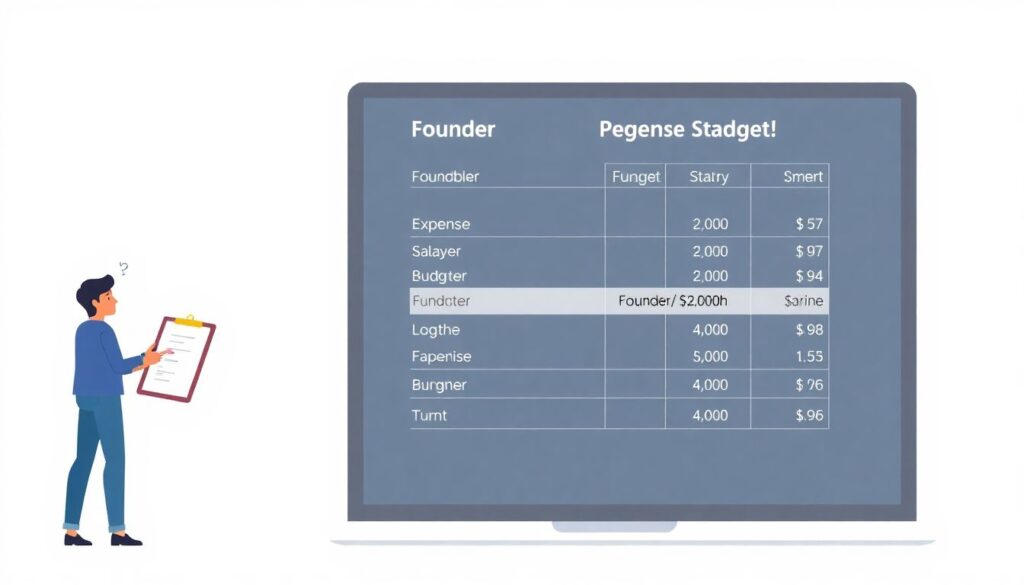
Many beginners leave their own pay out of the budget, thinking it will somehow “fit in later.” Instead, treat your salary like rent: non‑negotiable, even if small at first. Start with a realistic personal minimum — maybe $2,000 a month — and put it in as a fixed cost. One founder I advised refused to pay herself for 18 months, constantly “reinvesting” everything. On paper the company looked healthy; in real life, she was burning out and leaning on personal debt. When we added her minimum €1,800 monthly salary into the model, it became obvious that prices had to rise by about 15% just to make the business viable.
If your business can’t eventually afford to pay you, it’s not a business; it’s an expensive hobby.
—
Technical Corner: Tools and Templates That Make This Easier
Choosing simple software over complex systems
You don’t need an ERP system on day one, but using decent tools from the start prevents chaos later. Look for the best small business accounting software for budgeting that fits your size: QuickBooks Online, Xero, and Wave are common entry‑level options, with prices typically starting around $0–$30/month depending on features and country. The main thing you want is: 1) the ability to tag income and expenses by category, 2) basic reports (P&L, cash flow), and 3) simple budgeting or at least export to a spreadsheet. A photography studio I worked with moved from a messy notebook to cloud software and, within two months, finally saw that 25–30% of revenue was coming from upsold print packages they’d barely been tracking.
Software doesn’t make you disciplined, but it makes discipline far less painful to maintain.
—
Technical detail: Simple budget structure you can copy
Here’s a minimal structure for a budget template for small business startup you can rebuild in any spreadsheet:
Revenue: list each product/service line, quantity per month, price per unit, and total.
Cost of goods/services: materials, external labor directly tied to delivery, shipping, payment fees.
Operating expenses: rent, utilities, software, marketing, salaries, insurance, accounting.
Owner’s pay: shown clearly and separately.
Taxes: a percentage of profit (or revenue if your tax regime requires).
Aim for 20–40 rows total; more than that and you’ll stop updating it. A lean, regularly updated budget beats a 200‑row monster you abandon after week two.
—
Step 5. Turn Your Budget into a Monthly Habit
Compare plan vs. actual every 30 days
A budget is a hypothesis; your bank account is the experiment. Once a month, sit down for 45–60 minutes and compare: What did we plan? What actually happened? Where are the big gaps, and why? A tiny e‑commerce brand I advised did this on the first Monday of each month. Over time, they discovered their Facebook ads were only profitable when the cost per acquisition was under $18; anything higher, and they were effectively losing money on first orders. That insight came from consistent plan‑vs‑actual review, not from “intuition.” After they stopped running campaigns over that threshold, monthly profit jumped by about 20% without extra effort.
If you’re not reviewing monthly, you don’t have a budget; you have a static document.
—
Technical detail: simple metrics to track
You don’t need Wall Street dashboards. Three or four core metrics are enough for most small business budgeting services or DIY setups:
– Gross margin: (Revenue – Direct Costs) / Revenue. Aim for at least 40–50% in many service and product businesses; lower margins are possible, but then you need serious volume.
– Operating margin: Profit after operating expenses. Shows if your overhead is bloated.
– Cash runway: Current cash / average monthly expenses. Under 2–3 months is risky.
– Customer acquisition cost vs. first‑order profit: Are you earning more on the first sale than you pay to get the customer?
Monitoring these monthly will quickly show where to focus improvement efforts.
—
Step 6. When to Bring In Outside Help
Using experts without losing control
You don’t have to do everything alone. small business financial planning and budgeting consultants can be useful when your numbers get more complex — for example, you’re adding employees, raising investment, or dealing with multiple tax jurisdictions. The key is to treat them as guides, not magicians. A restaurant group I worked with hired a consultant who built beautiful reports that no one read; nothing changed. When they switched to a more hands‑on advisor who sat with the owner monthly and forced three decisions each session (what to cut, what to test, what to expand), profit margins improved from about 6% to 11% within a year.
If a consultant can’t explain your own numbers back to you in plain language, they’re the wrong fit.
—
What to outsource vs. what to keep
Here’s a simple rule: outsource complexity, keep decisions. Use small business budgeting services or bookkeepers for categorizing transactions, reconciling accounts, and preparing basic reports. You, as the owner, still decide on salary changes, price adjustments, and major investments. A solo agency owner I coached tried to outsource everything “financial” and stopped looking at her own reports; within six months she had no idea she was overspending by nearly $2,500 a month on unused tools and subscriptions.
You can delegate the work of preparing numbers, but you can’t delegate understanding them.
—
Step 7. Practical First‑Week Action Plan
What to do in the next 7 days
To make this real, use a tight, one‑week sprint. Day 1: Write down your three key decisions (your pay, hiring, marketing). Day 2: List all fixed and variable expenses from your bank and card statements for the last two months. Day 3: Sketch a unit‑based revenue model (how many clients, at what price). Day 4: Build a bare‑bones 12‑month sheet with those figures. Day 5: Add your salary and tax estimate (e.g., set aside 20–30% of profit depending on your country’s rules). Day 6: Choose and set up one tool — even just a simple spreadsheet if you’re not ready for software. Day 7: Review and adjust until the model doesn’t show you going broke in month four.
At that point, you officially have a working, if imperfect, budget for your small business.
—
Final thought: your budget is a conversation, not a verdict
A good budget doesn’t tell you “You can’t.” It says, “Here’s what has to change to make this possible.” Whether you’re bootstrapping a tiny online shop or running a local service and considering small business budgeting services later, the logic is the same: know your units, respect your costs, pay yourself, and review monthly. If you treat budgeting as an ongoing dialogue between your plans and your bank account, you’ll make calmer, sharper decisions — and your business will feel far less like a roller coaster and far more like something you actually control.