
Most people don’t really “find” their financial rhythm; they sort of stumble into it. Income comes in, bills go out, and everything in between feels like noise. Budgeting for Beginners: Finding Your Financial Rhythm is about turning that noise into a beat you can actually dance to. In technical terms, a budget is just a numerical model of your future cash flows: money in, money out, and what’s left. But for real people, it’s closer to a rehearsal schedule—when you’ll need money, what it’s for, and which parts of your life get to play solo. In 2025, with instant payments, subscriptions everywhere and financial apps pinging nonstop, a clear, simple system isn’t a luxury; it’s the only way to avoid drifting into debt without even noticing how you got there.
Key terms: income, expenses, cash flow and “financial rhythm”
Let’s pin down vocabulary so we’re not guessing. Income is every inflow of money you can reasonably count on: salary, freelance work, benefits, interest. Expenses are outflows: rent, food, streaming, loan payments, random late-night online shopping. Cash flow is just income minus expenses over time. If that sounds abstract, picture a bathtub diagram in your mind: the tap is your income, the drain is your spending, and the water level is your bank balance. Your “financial rhythm” is the pattern of those flows across the month—when the tap turns on (paydays), when drains open wide (rent, card payments), and when the level dips dangerously low. Budgeting is the process of designing that rhythm on purpose instead of letting it happen by accident.
Budgeting vs “winging it”: why intuition loses to data
Relying on memory and “I kind of know what I spend” is like navigating a new city with vibes instead of a map. It works… right up until it doesn’t. A technical way to describe personal budgeting for beginners is: building a low‑resolution, but accurate, model of your financial life using categorized data. In contrast, “winging it” is a fuzzy, constantly shifting model in your head, highly biased by recent emotions (hello, payday optimism). Studies on household finance consistently show that people underestimate irregular expenses and overestimate how much they can save “later.” Budgeting replaces guesswork with numbers, not to control you, but to show trade‑offs clearly: if you add a new subscription, where does that money stop going? When you see the trade‑off, you can choose it—or reject it—consciously.
Choosing a budgeting style: 50/30/20, zero‑based and envelope methods
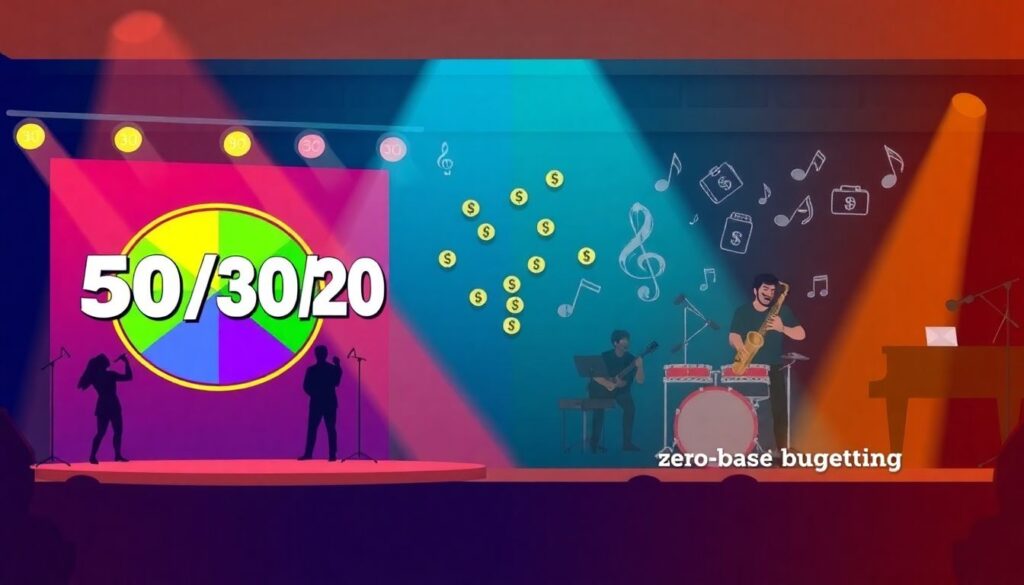
Think of budgeting methods as different musical genres: same notes, different rhythm. The simple 50/30/20 rule (roughly 50% needs, 30% wants, 20% saving and debt payoff) is like pop: easy to remember, forgiving, great for a first draft of your money life. Zero‑based budgeting is more like jazz with strict sheet music: every dollar gets a “job” before the month starts—rent, groceries, savings, or fun money—so income minus planned expenses equals zero. Envelope budgeting (physical or digital) divides your money into labeled pockets; when the envelope is empty, that category is done for the month. Technically, all of them rest on the same equation (Income – Expenses – Savings = 0), they just present it differently. For beginners, starting with 50/30/20 and then tightening into zero‑based once you see your real numbers works surprisingly well.
A diagram of your first budget: from chaos to three boxes
If you need a visual, imagine your money as a flowchart with three big boxes in a row. Box 1 is “Musts”: rent or mortgage, utilities, minimum loan payments, insurance, basic groceries, essential transit. Box 2 is “Future You”: emergency fund, retirement contributions, debt overpayments, savings for goals. Box 3 is “Nice‑to‑Haves”: dining out, travel, hobbies, upgrades instead of basics. In a basic monthly budget planner for beginners, your design task is to route every inflow through those boxes in order: fill Box 1 first, then Box 2, then let Box 3 consume whatever is left. This diagram turns the vague command “I should save more” into a system: savings are a box you fill, not an afterthought if something remains at the end.
How to start a budget and save money: a step‑by‑step reality check
Here’s a compact step by step guide to budgeting your money that doesn’t require spreadsheets obsession. Step 1: Collect three months of data (bank and card statements). Step 2: Classify spending into the three boxes above; don’t judge, just tag. Step 3: Compute averages per category—this is your “current rhythm.” Step 4: Decide your target mix (e.g., 55% Musts, 20% Future You, 25% Nice‑to‑Haves). Step 5: Adjust categories to hit that mix in the upcoming month: maybe trim food delivery, raise automatic savings, swap a subscription for a cheaper option. Step 6: Automate what you can—especially transfers to savings and debt. Step 7: Review weekly for 5–10 minutes and correct course. Technically, the only way you “save money” is when outflows are lower than they would have been without the plan; the system above quietly engineers those lower outflows.
Apps, spreadsheets, or envelopes: tools compared
Tools matter less than people think, but they do shape behavior. In 2025, the best budgeting apps for beginners plug directly into your bank feeds, auto‑categorize transactions using machine learning, and surface patterns: “Your average ride‑hailing spend jumped 40% this month.” They’re like fitness trackers for money—low friction, lots of graphs. Spreadsheets are more manual but more transparent; you see every formula, can build scenarios, and avoid subscription fees. Classic cash envelopes (or digital envelope imitators) are tactile and emotionally powerful: watching physical cash thin out hits different than a number dropping. Technically, all three are just interfaces over the same underlying math. If you’re data‑curious, use a sheet; if you crave automation, use an app; if overspending is your main risk, try envelopes for the problem categories like food, fun, and impulse buys.
From plan to rhythm: weekly check‑ins and feedback loops
A static budget is like a metronome nobody listens to; the real magic is in feedback loops. Once your monthly plan is set, the key habit is a short weekly review. As you log in, you’re basically running a control system: compare planned vs actual for a few categories, calculate variance, then tweak. Add a quick mental diagram: a loop with four nodes—Plan → Act → Measure → Adjust—repeating every week. This is exactly how engineers tune complex systems, just applied to groceries and rent instead of turbines. Over a couple of months, this loop slowly pulls your finances into a stable range where surprises still happen, but they no longer throw the whole month off. That “I know where I stand” feeling is what financial rhythm actually feels like from the inside.
Common myths: “Budgets are restrictive” and other misconceptions

Many people imagine budgeting as a permanent diet: no fun, just rules. In practice, a good budget behaves more like a meal plan designed by a sports scientist. It includes dessert; it just doesn’t let dessert replace dinner. Technically, the goal is reallocation, not restriction—moving money from low‑satisfaction uses (forgotten subscriptions, late fees, random fees) to high‑satisfaction ones (trips, hobbies, faster debt payoff). Another myth is that budgeting is pointless if your income is small or irregular. Where income is tight, the cost of not modeling your cash flow is actually higher, because one unexpected bill can cause cascading overdrafts. For irregular earners in particular, turning monthly averages into a lean “base budget” plus a flexible top layer can be the difference between constantly scrambling and feeling prepared.
Beginner workflows and personal experimentation
If you’re designing personal budgeting for beginners—whether for yourself or others—it helps to think in workflows, not rules. A simple beginner workflow might be: on payday, money auto‑routes to fixed bills and savings; you manually move a set amount into a “week’s spending” account; you check that balance before discretionary purchases. Another workflow: every Sunday, you open your monthly budget planner for beginners, compare category totals, and consciously choose one micro‑change for the coming week: pack lunch twice, use public transport once, or pause a subscription for a month. Over time, you’re doing light experimentation: tweak one variable, observe effects, keep what works. This empirical approach is why budgets can stay conversational and flexible instead of ossified spreadsheets nobody looks at.
2025–2030: where budgeting technology and habits are heading
By 2025 we’re already seeing early versions of “self‑driving budgets”: banking apps that forecast your balances, flag risk before it happens, and auto‑adjust savings targets when income changes. Over the next five years, expect this to intensify. Open‑banking data and generative AI will combine into proactive systems that not only track but propose a customized how to start a budget and save money plan, simulate outcomes, and negotiate some bills on your behalf. Conceptually, that means less manual categorization and more attention to high‑level decisions: trade‑offs between time, comfort and long‑term goals. But the core mechanics won’t change: you’ll still need to choose priorities, accept constraints, and revisit your plan as life evolves. Forecasts suggest adoption of lightweight, app‑based money coaching will climb, but people who understand the underlying principles, not just the interface, will get the biggest advantage.
Bringing it all together
Finding your financial rhythm isn’t about copying someone else’s perfect system; it’s about engineering a simple, robust pattern that fits your actual life. In practice, that means picking a method (50/30/20, zero‑based, or envelopes), choosing tools (app, sheet, or cash), and running them through that weekly Plan → Act → Measure → Adjust loop until the numbers start to match your values. The tools will keep evolving, and there will always be a “new” app promising an effortless fix. But the underlying discipline—a clear model of cash flow, conscious trade‑offs, and small continuous improvements—will stay surprisingly timeless. Once that rhythm clicks, budgeting stops feeling like punishment and becomes background music: always there, quietly keeping you on beat while you focus on living the rest of your life.